Unfortunately in the process of writing about the Romans here, I think I’ve failed to really grapple with those aspects of Roman society that stand out to me the most. Little by little I’ve poked away at data points…approaching a new object oriented thinking (thinking about the list and the data used to describe each point, e.g. location, date, etc.) has, I think, distracted me from thinking aloud (in writing) about the larger themes that interested me most in the first place.
I think also part of the problem has been that some of the most characteristic traits of Roman society as a whole seem to fall outside of the purview of this project. By this, I mean that religion, superstition, and tradition dominate the thinking and actions of Romans. These anthropological bits and pieces are, sadly, outside of what I can realistically grapple with in this project.
Despite these limitations, I still have room to think about those aspects of Roman society that intrigue me most. Or said more clearly, aspects of human behavior that I feel the Romans exemplify—the manner in which institutions and socialization operate in human psychology and the creation of value and purpose at the loci of power. Watching Rome made me think a lot about that, and I was able to grapple with those issues a little in my post about the politics of domesticity and Pompeii, as well as my fascination with Augustus. Art in Rome has illustrated the how values emanate from power centers more than any other medium that I’ve discussed.
Two new points of data that deal less with these lofty bits and pieces and more with the thinking of day-to-day Romans are novels in Latin: Petronius’s Satyricon and Apuleius’s Metamorphoses or The Golden Ass. Satyricon (on which Fellini based his famous film of the same name, shown above) is a risqué narrative of the misadventures of everyday, brutish and sexually charged Roman plebeians. It paints a good picture of everyday life and language at that time and place. The Golden Ass follows a somewhat classic Roman literary premise that draws a great deal on Menander and New Comedy in its “lover finds lover, lover loses lover, lover refinds lover” structure. It also deals with some of the things I’m really interested in by dealing with form, transformation, and operating on the margins of society. These both make the list.
The historical Jesus next time.
Showing posts with label Ancient Italy. Show all posts
Showing posts with label Ancient Italy. Show all posts
4.07.2009


2.04.2009
Schools of Thought in Rome, and the Intellectual World of Cicero
I've recently wrapped up an examination of Cicero, approaching him from the context of the vast array of beliefs and philosophies that thrived throughout Roman territory and the Mediterranean generally. This diversity of thought prevailed for centuries before Cicero, and would continue for centuries after him. What strikes me as peculiar and challenging as I try to understand the opportunities for contemplation available to Romans is the lack of any real mainstream or state sponsored religion. As long as the populace respected state sponsored holidays, it seems like people could worship pretty much whomever or whatever they wanted.
Gods like Jupiter and Minerva are among many forces in the world unseen that can have an impact on our lives. Ancestral worship, carried over from the Etruscans, remained a major influence in people's lives, as has been noted in my first post about Roman art. Superstitions used for good luck or for curative purposes, originating from God-knows-where, abounded. Foreign influences that entered the Roman realm as its borders expanded also paved the way for foreign religions, and the activity of priests that guarded the associated rites and rituals. Worship of Ra and other Egyptian deities came into vogue in Rome even before the inclusion of Egypt into the Roman empire after the Battle of Actium, and interest in Egyptian culture and religion positively exploded among the upper classes in the century that followed. Groups dedicated to Mithras, from Babylon and Persia, as well as Sumerian astrology were not uncommon among even the most mainstream Romans. An abundance of figures from the Greek pantheon had their own worshippers, centered around temples and oracles dedicated to that god alone. Major changes were afoot in Judaism, but it was Herod, the King of Judea and a servant to Rome, who rebuilt the temple, and by the turn of the millennium we begin to see the growth of Rabbinic Judaism, gnosticism, and that little subsect of Jews known much later on as Christians.
Well, now that I've finally got all that philosophy stuff out of me, I can begin to add some new writings to the list. The problem with many of the aforementioned schools of thought is that few primary sources exist. Therefore, I will satisfy myself with adding Diogenes Laertius's Lives of the Eminent Philosophers, which for many centuries has been the go-to text for hearing accounts of the lives and teachings of guys like Zeno (stoicism), Epicurus (epicureanism), and Diogenes (a different Diogenes--this one helped to found cynicism). In addition, I'll be adding a couple of other writers to the list along with Cicero and his Laws, specifically essays by Seneca the Younger (a stoic philosopher and tutor to Nero), and Emperor Marcus Aurelius's Meditations (Marcus Aurelius was also very scholarly and a stoic, and reigned at what is likely the height of Roman power). Next up, literature in the age of Augustus, Roman novel writing, my last post on art, and Plotinus (The founder of neo-platonism and the last great philosopher of antiquity). Then on to the Christians...
Of greatest interest to me is the persistence of philosophical schools throughout the Roman empire, with their roots as far back as the Academy in Athens and enjoying widespread popularity across the Mediterranean. When understood in the context of the diversity of options for religious devotion, these competing schools of thought (literally) amaze me. The teachings of men like Epicurus, Zeno, and Diogenes boggle my mind, not necessarily because of their insights, but because their lessons and views provided the basis for centuries old traditions of teachers and scholars that propagated and added to the original thinkers' work. I am stunned and in awe watching a body of data become a discourse, to see it transmit and grow independent of politics or geography.
This was the intellectual and contemplative world of Rome--for the elite, almost limitless availability to a variety of world views and teachings. Greek methods of teaching persisted, becoming all the more prevalent once Rome defeats Greece. Members of the Roman upper class brought literate and well-educated Greeks (often enslaved) to educate their children. Wandering sophists gave lessons in math, philosophy, and rhetoric, much as they did in the Greece of Aristotle. Societies of men devoted to cynicism, stoicism, and epicureanism (among many others), set up schools in all the major cities to inculcate interested students in their system of thought. Much like the syncretism of Roman art, philosophy also enjoyed an eclectic heyday under the Roman empire, wherein one chose that which suited him best.
Cicero, for his part, chose Academic skepticism. First advanced by Pyrrho, a former soldier in Alexander's army, and later promoted by Pyrrho's disciple Timon, does not receive a good review from my friend Mr. Bertrand Russell: "Scepticism," he writes in The History of Western Philosophy, "was a lazy man's consolation, since it showed the ignorant to be as wise as the reputed men of learning" (pg. 234, see links on the right for copyright and citation info on my edition). In my mind, however, skepticism seems the most obvious heir apparent to thinkers like Isocrates and Plato, who questioned through dialectical reasoning the very premise of deductive reasoning itself. In fact, for many years after the death of Aristotle, the Academy remained the center of Academic skeptical thought. Cicero, for his part, believes as Plato did: that although one can be convinced of the greater probability of one argument over another, he will never achieve absolute certainty of the truth. Although it doesn't seem that he ever makes a metaphysical leap as Plato does from this spot, causing him to question sensory experience in general or considering a metaphysical sphere beyond rational thought, he channels this assumption into some very cunning political writing. As such, his thinking is although remarkably similar to Aristotle's in terms of the discussion of a politician/philosopher duality and the way by which one creates a great city and state. It's practical, and, well, skeptical of everyone's motives, but still seems to express real optimism by remaining firmly planted in this sphere (unlike Plato). His greatest concern is to translate the thinking of Plato, Aristotle, and others into his time and the circumstances of Rome itself, and trying to make sense of it in a way that would be useful to building a great state. This is a stellar example of the peculiar creativity of Roman syncretism.
1.13.2009
Art and Philosophy in Rome, Part II
Pompeii and the Roman Villa, now on display at the National Gallery of Art, displays an impressive abundance of antiquities in a city built on the classical tradition. Washington D.C. lacks a sizeable permanent antiquities collection of its own (Dumbarton Oaks comes close, but focuses largely on Byzantine era antiquities and is downright cute in its size), so I anticipated the show as a rare treat at observing something classical in my hometown. I did so twice: the first time out of excitement, and the second time out of defiance. My friend Tyler Green, writer of Modern Art Notes, had heard through the grapevine that the show was poorly curated and told me so before I visited. As a lover of all things classical, I didn't want to believe it. But sometimes one just has to face facts. Despite so much good stuff on such an oft studied topic, I thought Pompeii and the Roman Villa was junk. Where did they go wrong? Did the staff overreach? Organize poorly? Miss the point of a museum's existence in virtually all of the material they presented? All of the above, I say.
Drawn largely from collections in Naples and the surrounding region of Campania, home to Herculaneum and Pompeii (of volcanic destruction fame), the exhibition focuses on the Republican and Imperial Roman decorative arts of the seaside villas around the Bay of Naples. The premise for the show itself is a good one...the domestic art and architecture of the Roman elite. It's a fascinating subject in its own right, as it touches on many of the subjects related to memorializing one's pedigree (which I touched on in my last post on Roman art, here), as well as showing the infinitely more political side of Roman life. That's right, more political side. Monumental architecture so known and loved (and about which I'll write more in the future), sought to commemorate the victories of Rome's sundry senators, generals, and emperors. It deified them, and shrouded them with symbolism that would resonate in the mind of the cadres of uneducated plebes who would be compelled to fight, either in the army or in riots, to further the political ends of the state leadership. Monumental art is just public oratory in shapes and forms, with a premise and pursuit.
Domestic art is certainly not without pursuit. It's just more crafty about it, like wearing your nicest suit to the interview, or buying a new dress for a gala. It's about appearances to those whom you hope might propel you or your family higher on the social hierarchy, or increase your wealth through marriage or the umpteen other kinds of alliance that manifest in the sphere of politics. These are the people impressed not by the giant triumph built near the forum, but by the title of the man for whom it was built, and what a closer social proximity to that man could do for them. Most striking to me, villa life seemed most of all the domain of femininity, where women became as powerful political operators as their male counterparts, leveraging traditional social norms like child bearing and arranged marriage, social visits and adornments for the family's political and commercial pursuits. I'm reminded of Catherine Allgor's Parlor Politics, in which the author describes how Washington itself was built by precisely this kind of political domesticity.
This was the place of otium, or leisure, as opposed to negotium, or work and business. Wealthy Romans from as early as the 2nd century BCE, still 100 years before the fall of the Republic, would build lavish summer homes around the Bay of Naples. This convention continued once Augustus came to power as Emperor, and for years after until the eruption of Vesuvius in 79 CE, which buried Pompeii and Herculaneum and have since turned them into the stuff of legends. Surrounding areas also became major trading ports, bringing money into the area from Mediterranean trade in grain from Egypt and other newly acquired Roman lands. Propelled by so much wealth, the seaside villas serve as fabulous exemplars of what art in this sphere. It communicates above all the values of those commissioning it, importing it, and buying it, and what they wanted to express by showing it off at home to guests. These are some of the finest art works at the highest level of craftsmanship available at the time, and as a text is rich with information about the society that possessed and financed them.
Examples of this context abound in Pompeii and the Roman Villa. Iconography from Egypt and Greece demonstrate the diversity of stylistic influences present among the Roman upper classes, but in a funny way, turning noted statues of gods and nymphs into candle holders and tray bearers. Mosaics of gardens, dinner parties, and Plato express a desire to create a particular mood. Paintings of the villas, to be displayed in the homes they represent, communicate a sense of pride and ownership, and capture an unspoiled moment in time, an escape.
So how does one reconcile these depictions with the idea that this was the sphere of real politics? Certainly it wasn't all black and white, nor can we characterize anyone as a single-minded political machine. But in the villas, this was leisure time...this was where one showed what he or she thought was beautiful (or thought was supposed to be beautiful), or revered, or special. I think it's most likely that those who actually enjoyed these leisure activities did have an opportunity to pursue them, and those who really didn't got to act like they did. I found the figurative depictions of scrolls, writing implements, and scrolls, especially remarkable...this was where one came for his or her own edification--moral improvement, if you will, outside of the dastardly goings-on of the capital city. Or at least showed you did. I like the mosaic of Plato with his students at the academy and the bust of Homer most of all with regards to this point. Most impressive were the consistent portrayals of Dionysos, the Greek god of wine and merrymaking. This is where you came to cut loose with friends, drink too much wine, have parties and meet people. Not the politic cocktail reception, but the drinks at the bar after hours. Rome was a peculiar place when it came to religion--there were any number of gods that one could worship, and the metaphysical realm was hardly an exclusive club. Almost all of them were accepted into the fold, and as long as one gave proper respect to the gods associated with the state, one could worship whomever he or she wanted...Mithras, Isis, Dionysos. Whatever. Leisure time provided ample opportunity for this sort of spiritual pursuit...especially for those committed to our friend Dionysos.
I'm sure at this point, after so much glowing about the material the exhibition features, the reader wonders why I would be so hard on the curating of the exhibition itself. The first time I visited was before the public opening of the exhibition, reserved for National Gallery of Art donors, which I entered by using my old employer's name. We started with a lecture by the curator herself, which was an excellent introduction into the premise of the show. But after it was over, and we entered the exhibition, I was stunned by how...dumb it all was. The context given in the works' presentation was misguided, favoring the place and the fanciness over the actual historical context. It left me feeling that I should revere this stuff just because it was Roman and old. I walked through feeling that the work there had all been done a disservice, treated as marginal Roman art, less interesting than the monumental architecture scattered about Rome or the famous busts at the MFA in Boston or the Metropolitan Museum of Art in New York, and that this was just a hodgepodge of hand me downs that the NGA could manage to cluster together. This, as the preceding paragraphs suggest, is not in any way the case. Instead, they played to the crowd, and I found it base. I visited a second time, thinking that another viewing where I could spend more time with the work would be helpful. I left irked again, miffed like a scolded child at trying to understand things that were beyond me.
Curating, in my mind, should be a rubric of value. It should be a guide to says here's why this was valued then, here's why people have valued it through the ages, and then asks, now what value do you find in it? And although I hate to prove him right (this out of sheer defiant pride), Tyler was right when I first discussed the show with him, and he told me the reason behind the rumors that it was crap...no curating. This show was the work of an arts scholar, who gave a fantastic lecture but couldn't put it together in a show. She couldn't find that common vein, instead leaving these valuable pieces in that b.s. wasteland where a lot of fine art and antiquities are placed...for rich people to feel cultured, to revere old stuff just for the sake of being old, for being Roman or Greek. I imagine curating in the antiquities is a very tough job, trying to present art for an audience for whom that art was not produced, and who ultimately have an exceptionally different worldview that is probably impossible to really understand. And the vehicle for interfacing between the works and contemporary audiences, the mystique of Pompeii through the centuries, was astoundingly boring, out of place, and made the whole thing feel disjointed. Specifically, here's what I think they did wrong:
- Overreached: The curatorial staff should've taken everything out of the show that wasn't explicitly an object of antiquity. That stuff about the eruption of Vesuvius, the 19th century oil paintings of its eruption, and the attempts to copy those antiquities in later years was awful. They had plenty there to make an exceptional exhibition, and I think they added the other sections to make it more "current" or "timely". The last two parts, one of which featuring representations of the explosion of Vesuvius and the excavation, and another a painting by Sir Lawrence Alma-Tadema depicting a sculpture garden (displaying alongside it many of the sculptures he painted), were the worst parts of the show, and must have taken a ton of time and money for all the necessary loans.
- Organized Poorly: All the bells and whistles added to the works to make the garden party theme more believable still didn't save it. According to the NGA's press release on Pompeii and the Roman Villa, the show is divided into five parts (this is news to me, as it is only vaguely alluded to in the brochure): "Patrons at Home", "Courtyards and Gardens", "Moregine" (the site near Pompeii where the frescos this section displays were discovered), "The Legacy of Greece", and "Rediscovery and Reinvention". This organization pained me--as a result of it, everything felt mismatched. Wall text seemed totally out of context or forced, especially in an environment were anything depicting myth got thrown in with "Greek Influence".
- Missed the Point of a Museum's Existence: I go to a museum to be able to engage as I please with some pieces, skip others, and spend ages staring at just a few. I know in a visiting exhibition, as opposed to a permanent collection spread, the intent is a little different. Everything just felt so Disneyland though, and it actually read to me like an academic's first foray into public history or art presentation, as if she felt like it had to be dumbed down to get the masses to appreciate and enjoy it. I know that the NGA can put on a first rate show that makes you feel smarter for having seen it and considered it. But in the end, this asked no questions of me...just put several objects together to fit the research that Matusch has been doing for years. Start with the art, not with the academic paper.
I'm pleased that I got to see all these works, I really am. But I'm disappointed with how it was presented. Ultimately, I felt that Pompeii and the Roman Villa just buttressed prevailing images of Greece and Rome, cordoning off these critical times in Western intellectual and cultural history as something we're supposed to learn about and supposed to appreciate, but by the time we're done we just want to go home. With so few antiquities in Washington, and so much legacy here that draws on precisely that tradition, I gave a sigh reserved from a huge missed opportunity. I guess there's always Dumbarton Oaks, and Baltimore is just up the road...
1.02.2009
Cato, History, and the Illusion of Conservativism
I often think of Cato these days when considering the Romans. Now that I too have lost pretty much of all hope in achieving the ideal that I once thought meant something, I think I can sympathize with him a little bit. Cato was a Roman senator, tough as nails apparently and a “real Roman”. Perhaps the most salient reason that I think about him lately is the motif he seems to represent. Horribly distrustful of the growing influence of Greek culture on Roman society, Cato called for a return to true Roman values. He believed they’d been disintegrating as a result of laziness and frivolity among the Roman upper classes. He blamed, among other things, the introduction of Greek thinking, carried on the back of Greek art, music, and philosophy, to Roman society
I note this because it seems that as the Romans approach the age of Augustus, the literature and poetry of Rome communicates a growing conflict that reflects Cato’s complaint. This is so at least among those lyricists and writers receiving the patronage (or disapproval) of Augustus and his chief arts liaison, Maecenas, and from a broader perspective among the political and societal programs of Augustus himself. By legislating and promoting certain societal values, Rome’s first emperor Augustus sought to recreate Rome according to an image, real or not, of time centuries before. This was the Rome of the Punic Wars, wherein Rome defeated the Carthaginians to the west (mid-third to mid-second centuries BC); the Macedonian Wars, fought at the same time as the Punic Wars and consequently knocking out every single Alexandrian kingdom to the east (with the exception of Egypt, which would fall under Roman control with the death of Cleopatra and the battle of Actium in 32 B.C.), and decimated the Gauls led by Vercingetorix to the north (this was Julius Caesar’s great achievement, called the Gallic Wars).
To be frank, I couldn’t care less about military history—tactics and generals, and so on and so forth. That stuff's for geeks and old men. My interest in these battles is understanding the heroes of Rome, and seeing the process by which Rome came to dominate the Mediterranean basin and what is now southern Europe and the Iberian peninsula. Furthermore, I wonder—how did a pseudo-democratic society manage such an expansion, and what tools did they use to effectively impose Roman control on regions so far away from the metropolis? Most critical to my study of these times is to see how cultural production reflects the societal dynamics put in motion by these events, and what kind of cultural identity resulted from them. Militaristic, certainly…but not just savage. This was a military controlled by the senate, a body whose norms and rules had been established over centuries. Rome’s successes—the glory of Rome, as it were—came to form the legend that would provide a basis for Roman patriotism, a critical component of Roman identity (given how dispersed Rome’s empire became, ethnic identity seems only a vague contributor to culture. Pedigree, however, is a different story. See my last post). The system that enabled these achievements, and the values that system socialized into those under its purview, would be just as critical to the identity, then, as the successes themselves.
Hence Cato’s complaint. As Rome becomes richer and more powerful, absorbing other cultures into its fold, the Greek civilization becomes one of the most popular societies of the past that Roman upper classes emulate. Art pieces are imported and copied constantly, and there’s a renewed interest in the writing, music, and philosophy of Rome’s Mediterranean neighbors. As noted in my last post, Rome did not just become Greek culturally. They took Greece and its products. The underlying dynamic of that process is one of the most characteristic components of Roman culture. And Cato hated it. He thought that Rome was losing sight of those values that had made them great, values that essentially made emulating Greece possible in the first place. Furthermore, he blamed a loss of patriotism for the greed that propelled the great Roman civil war forward that led to the rise and fall of Julius Caesar. He wouldn’t live to see defeats of Marc Antony and Brutus, and the eventual foundation of the Roman Empire under Augustus.
So what was for centuries a powerful Republic began to get shaky, and allowed for the eventual success of dictatorship (Don’t even think of making comparisons to the present—those conversations are so boring. If anything, look just at organizational dynamics. The United States is nothing like Rome, and doesn’t even approach the hegemony that Rome enjoyed. That is the first, and false, assumption made by those that compare the United States to Rome.) I was able in my last posts to show some of the culture that came out of Rome in the second and third centuries BC, right when Greece was on the wane and the Alexandrian kingdoms emerged. Now we enter a new era…the Roman Republic becomes pretty much the only game in town, and has swallowed up a bunch of other civilizations in the process. What does the last century of the Roman Republic look like? What were people thinking once Augustus came to poweer, and how does culture operate as a "technology of power"? How does understanding the context discussed above help to see the place of writers like Catallus, Horace, Virgil, and Ovid? What the heck was Cicero talking about, and how did philosophical schools like the Stoics and Epicureans come to dominate Roman philosophical thinking? Those are in the posts to come…posts that will be much richer as I understand what Romans like Cato and Augustus believed they lost, and wanted to get back to, and why we still read the things we do (answer: Virgil and Horace were on the Imperial payroll. Ovid was not by the time the Metamorphoses was written, making a cut and dry thesis on patronage a little difficult). And what the hell is a Christian, anyway?
For this post, I’m adding the extant parts of Livy’s history of the Roman Republic, From the Foundations of the City, to the list. Livy’s history covers several centuries of republican history, much like Herodotus’s Histories. Livy’s is interesting, though, because it’s written in a rhetorical, and thus somewhat persuasive style. His intent? Very much in line with what I’ve discussed in this post…he is forthright about his desire to demonstrate that the morals of Rome in his own time (59 BC through 17 AD) had degraded, and that everyone had to get back to the moral code on which Rome was based. His story that best encapsulates this commitment is the famous story of the Rape of Lucretia, in which sexual assault against the protagonist leads to the punishment of the man who did it and the eventual overthrow of the Etruscan kings and the establishment of the Roman Republic. Lucretia herself commits suicide, not because she is dishonored, but because she doesn’t want unchaste women in the future to ever have the option of lying about being raped as a cover for their adultery. Intense.
10.13.2008
The Etruscans and Emerging Italian Peninsula
Studying the Etruscans has reminded me of another time this project. Prior to the Greeks, I spent a while on the various tribes of Mespotamia and early Mediterranean civilizations (e.g., the Phoenicians, the Minoans…). I feel like I’m doing that again—laying the groundwork for the next shift in power, away from the Aegean to Rome. After all, the Etruscans were just another Italic tribe. I think the Etruscans are known to us in particular because of their well-preserved art and for the conquerors, the up-and-coming, mixed nation tribe centered in the city of Rome.
What’s important for me to note is a lesson I can take with me as I encounter new nations that the Canon encounters in its forward movement (e.g., the Celts, the Cossacks, the Gauls, etc.) These are distinct nations with equally distinct cultures, very much rooted in the realities and circumstances of their respective times and places. With luck, they add a little something of their own to the Canon or become insular enough to escape co-optation and disintegration under foreign rule (see Roma). If unlucky, they fade away into the legend bin of conquered peoples (see Carthage).
The Canon, the list—that culture without a place. It’s a juggernaut. Domination and it have a productive, two-way relationship, and have scratched each others’ backs for millennia.
The Etruscans are among those who managed to add something to the Canon. The Romans carried with them Etruscan sensibilities and religious trappings (by the time the Romans emerged, the Etruscans practiced an amalgam of Greek religion and their own inherited forms of fortune telling and superstition). The art that remains with us gives a glimpse of a society that, although never confederating beyond a series of city-states, had a unique set of cultural practices and history.
Where did they come from, and what was their source? Herodotus suggests Lydia (incredible article here about that), which has some evidence. Indo-European or Phoenician seems equally plausible and a bit more fun to me. They have so much in common with the Greeks of Antiquity and before, with their own regional spin, that there’s something shared there.
In sculpture and decorative arts, we see some differences, but not many. The Etruscans were fantastic metalworkers, and their methods of filigree and granulation still confound scholars. In sculpture, the distance between the cultures is slimmer, although important differences represent the enormous impact that available materials can have on art. Compare these statues:


Similar form, but more gesture in the Etruscan. Whereas the Greeks used marble for sculpture, the Etruscans used terra cotta, a material that allowed for much greater experimentation with movement and creating detail in faces. Many works also show the same Orientalizing and Egyptian influence seen in the Greeks as well.
Despite these similarities, I have to ask myself, what did they add? Therein do I get the real perspective on the Etruscans. It seems likely to me that, at least as far as art is concerned, the Etruscans and Greeks of antiquity shared the same source material, the product most probably of significant cultural sharing as a result of trade networks. But as much as I like to read into the text that aesthetics represent, ultimately I think these are just fashionable stylings, stretched out over centuries. The Greeks themselves didn’t really create anything original until the 5th century, and that work was influenced by a major shift in how artisans thought about their work—an artistic commitment rooted in new ideas about the world. I doubt few of the values of the Greeks and Etruscans had much in common at all. As for the transmission of ideas were concerned, the Etruscans and other Italic people were their own men and women with their own assumptions and beliefs. They shared a vehicle of expression with the Greeks, and that’s all. Those contributed to the formation of the Roman people, not the aesthetic sensibility alone. And I’ll just have to see what that really means when I get on with the Romans themselves.
One thing I can peg now on an Etruscan to Roman link. They gave them the arch:
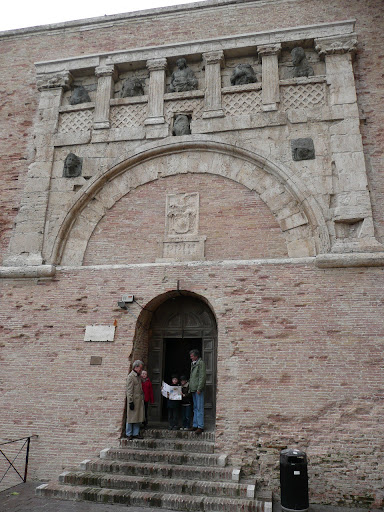
And the Romans ran with that just fine.

What’s important for me to note is a lesson I can take with me as I encounter new nations that the Canon encounters in its forward movement (e.g., the Celts, the Cossacks, the Gauls, etc.) These are distinct nations with equally distinct cultures, very much rooted in the realities and circumstances of their respective times and places. With luck, they add a little something of their own to the Canon or become insular enough to escape co-optation and disintegration under foreign rule (see Roma). If unlucky, they fade away into the legend bin of conquered peoples (see Carthage).
The Canon, the list—that culture without a place. It’s a juggernaut. Domination and it have a productive, two-way relationship, and have scratched each others’ backs for millennia.
The Etruscans are among those who managed to add something to the Canon. The Romans carried with them Etruscan sensibilities and religious trappings (by the time the Romans emerged, the Etruscans practiced an amalgam of Greek religion and their own inherited forms of fortune telling and superstition). The art that remains with us gives a glimpse of a society that, although never confederating beyond a series of city-states, had a unique set of cultural practices and history.
Where did they come from, and what was their source? Herodotus suggests Lydia (incredible article here about that), which has some evidence. Indo-European or Phoenician seems equally plausible and a bit more fun to me. They have so much in common with the Greeks of Antiquity and before, with their own regional spin, that there’s something shared there.
In sculpture and decorative arts, we see some differences, but not many. The Etruscans were fantastic metalworkers, and their methods of filigree and granulation still confound scholars. In sculpture, the distance between the cultures is slimmer, although important differences represent the enormous impact that available materials can have on art. Compare these statues:


Similar form, but more gesture in the Etruscan. Whereas the Greeks used marble for sculpture, the Etruscans used terra cotta, a material that allowed for much greater experimentation with movement and creating detail in faces. Many works also show the same Orientalizing and Egyptian influence seen in the Greeks as well.
Despite these similarities, I have to ask myself, what did they add? Therein do I get the real perspective on the Etruscans. It seems likely to me that, at least as far as art is concerned, the Etruscans and Greeks of antiquity shared the same source material, the product most probably of significant cultural sharing as a result of trade networks. But as much as I like to read into the text that aesthetics represent, ultimately I think these are just fashionable stylings, stretched out over centuries. The Greeks themselves didn’t really create anything original until the 5th century, and that work was influenced by a major shift in how artisans thought about their work—an artistic commitment rooted in new ideas about the world. I doubt few of the values of the Greeks and Etruscans had much in common at all. As for the transmission of ideas were concerned, the Etruscans and other Italic people were their own men and women with their own assumptions and beliefs. They shared a vehicle of expression with the Greeks, and that’s all. Those contributed to the formation of the Roman people, not the aesthetic sensibility alone. And I’ll just have to see what that really means when I get on with the Romans themselves.
One thing I can peg now on an Etruscan to Roman link. They gave them the arch:
And the Romans ran with that just fine.

Subscribe to:
Posts (Atom)


