Showing posts with label Pythagoras. Show all posts

7.01.2008

Order/Disorder Part 1: Limit

In a two part series to finish my exploration of the Greek body of text called Order/Disorder that I introduced in my last post, I discuss in two entries the basis of the moral code derived from a belief in a cosmic order, and the cultural production that resulted as adherence to that morality began to wane. Here, I build on the idea that order and logic provided the basis for Greek cultural and intellectual production throughout much of the Classical age, and suggest that this corresponds with the spread of Pythagoreanism.

The process of understanding Pythagoras has made the dynamic Greek civilization more understandable to me, especially as I’ve placed analyses by guys like Snell in a more informed historical context (It’s been very hard to find a discussion of Greek intellectual and cultural history that actually discussed sources). The Greek myths best known from the works attributed to the bard Homer had existed for centuries by the time Pythagoras appears in text in the early 6th century BCE, and a comparison of the two paradigms that the two aforementioned thinkers represent reveals the way in which thinking could open up, allowing for new perspectives of the self, the soul, and the nature of the physical world. The ancient Greek mythology that we all know and love relied on a set of assumption with only a very loose understanding of the body and what animates it, and believed in a pantheon of gods with all the caprices and brutality of human beings. Fate unfolds without any design, the threads of space knit together by the blind almost by chance, and as the tapestry forms across time, gods and men act and react within the physical world we can perceive with the senses. Kosmos (order), on the other hand, has purpose. The world operates according to a larger system—objects in space are units that operate as part of the whole, each with a value defined by an overarching structure. It gives man a new power—the ability to know and predict. It also gives him a personal space and individual choice (the source of the concept for the soul, be it material or immaterial).

Pythagoras gets credit for being the first transmitter of this kind of thinking, which would have far reaching effects on the Greek body of text that unfolded over the centuries following his life. Certainly Pythagoras was not the first to suggest some greater order to the universe—not only had he received an education in Egyptian and Babylonian traditions, he also continued the ancient Greek tradition attributed to Orpheus and his cult and before that, Dionysus. However, the rise of Pythagoreanism (at present ignoring his possible sources), corresponds to the rise of a different way of thinking—the growth of the cult of Apollo (which ceases to see him, and the muses which follow him, as very human-like creatures—anthropomorphic—and more like the ideal being and keeper of the order and of its revelation), and the burgeoning prevalence in text of references to the self and the individual mystical experience, that ecstatic moment of awe and wonder at the world and one’s place in it.

The nitty-gritty of Pythagoreanism revolves around number—but not as we would think of it; certainly, it’s almost violent to consider putting as much faith as they in what the contemporary mainstream would consider coincidence. Pythagoreanism itself took me quite a while to wrap my head around, and I had to research a great deal (thank you to Christiane L. Joost-Gaugier’s excellent book Measuring Heaven for its analysis of the growth of the Pythagorean school and its impact on art from the Classical period through the Middle Ages). I even visited New York City just for the day to attend a philosophy chat to which I was invited at Logos Bookstore on the Upper East Side just to ask the publishers who were sponsoring it some questions about Pythagoras’s number theory and ethics.

Fundamentally, it requires a different concept of numbers altogether, one not of magnitude (like how many apples are in a barrel, times 8 barrels, etc.), but of limit and definition—points in the infinite which, when seen as a series, provide structure for and make sense of the vast indefinite. The analogy of the monochord pulled it together for me—like on a guitar, where one can push the string an infinite number of places to create a new tone, one must have a sense of proportion with the original string’s length to really develop a system of tones based on ratio. Although the units one would choose to make those ratios (3/4, 8/9), etc., may seem arbitrary in an absolute sense, when utilized consistently in a defined system it makes a perfectly logical operating system. Thus, number does not have value in and of itself, but only relative to other points in the system, regardless of whether that system is constrained on a line, on a surface, in space, and in time.

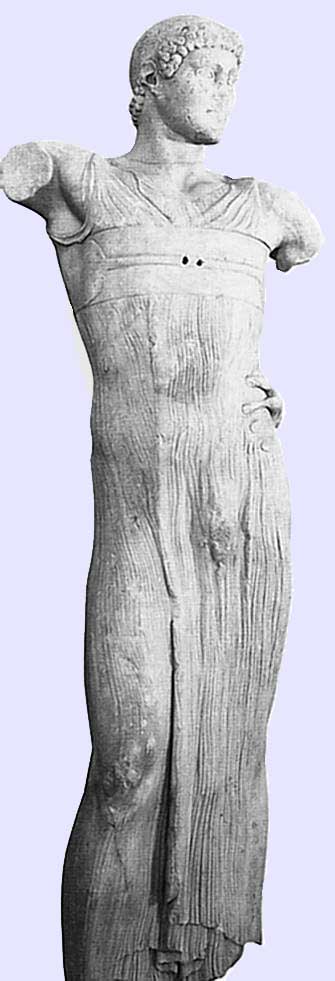
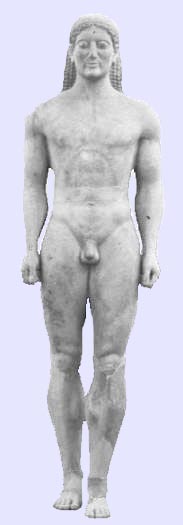
I know it seems kind of nutty, but its actually wildly fun to figure out and really throw yourself into—no longer seeing just components, but the entire system and its intended operation. The Pythagoreans believed that the existence of ratios at all was not the order itself, but simply evidence, a reflection, of the larger system and design to all planes of existence (there are myriad approaches to the questions that this perspective allows relative to the end point of this whole system, the place of the individual within it, and so on. Please see my Plato post for just a couple of these responses by the thinkers known as the Pre-Socratics and by Plato himself). And so much Greek cultural and intellectual production reflects this assumption…statues that take into account the entire human form in order to create the image of an ideal man; temples where every angle and span work together in order to create a structure that inspires a sense of awe and majesty; an oral argument that makes the listener dive into his very beliefs and come away from the speech thinking differently about himself and his society; a social structure whose sole purpose is the just, and the good, and the right.

All these examples I list, though, hinge on a the creator’s commitment to a fundamental concept, and as I consider them it seems very clear to me how (certainly not why...that I'll explore later) the Greek text began to fall away from this manner of seeing artistic production into a world of disorder and confusion, as Greek civilization did by the early 3rd century BCE. The fundamental concept to which I refer is harmonia: the idea that the producer created a form of true beauty through its logical consistency, through its application of components whose value derived from a central rubric centered on the purpose of the form. Furthermore that the very purpose of creating the form was to coincide, or harmonize, with the greater order of existence. That is a question of morality—a commitment to the grand design by creating a system whose purpose worked toward that design’s intent. Thus it’s not a casting off of logic—certainly not—but a hazy idea of why one should use that logic at all. And that’s a matter of faith and personal purpose (I would suggest that the whole thing requires an initial inductive leap, but that’s because I’m an immoral person). As the Greeks discovered the power of a logical system, be it in music or oratory or art, many began to utilize it for their own personal gain instead of a moral code based on a concept of the universal order (see my post on rhetoric to read my own exploration of the philosophical problems caused by the work of the sophists, and a discussion of dialectic argument as a part of that inquiry). By the time Alexander rolls around in Greece, the body of text that we’ve inherited reflects a slowdown (although certainly not an end) to inquiry into the nature of order, and a greater priority given to functional knowledge created for the sake of application (See Euclid and Archimedes), without a coinciding discussion of the merit of the creator’s intent and the endpoint he or she pursues.

And so we see the philosophical discussion pushed to the edges in the new world of disorder. There, the schools and tribes of marginalized peoples who carried on the mystical traditions of the past would give birth to Stoicism, Skepticism, and of course, Christianity. Although Christianity will have to wait until the Italian peninsula and Rome, next post I’ll discuss Hellenistic literature, art, and other philosophical movements as I explore culture in a world of disorder.

6.28.2008

Introduction to Order/Disorder

It’s becoming difficult to focus my thinking as I approach a point where I’ll map the network I created over the last year and analyze it in a larger piece which I hope will bring everything together. So in an attempt to tie loose ends I will write two more posts, both entitled Order/Disorder. The first will discuss the rise and importance of order in Greek text, the influence of Pythagoreanism in the arts, and the larger themes of math and music. The second will address philosophical movements like the Cynics and Epicureans and literary moments like New Comedy as confidence in a fundamental system wanes in the most prevalent texts from the later centuries of Greek Antiquity.

4.01.2008

Turtles all the way down...


All told I’ve spent months working on Plato and placing him within my network. And believe it or not, this post discusses him and his work. I haven’t had any real major epiphanies with this one, which doesn’t present any dilemma per se, just the curious development of something coming together and making sense for me through lots of research and thinking alone. No moment of inspiration in the shower, no butcher paper on the walls as I paint words across bare space with charcoal, swigging on a bottle of wine and listening to A Love Supreme while my girlfriend expresses concern for me relative to my mood disorder. I hesitate, for fear of reverting to my well-utilized dramatic organ, to suggest that my method of thinking seems to operate analogously with whatever it is I’m studying, that I’ve moved beyond the age of inspiration from the muses into an age of quiet contemplation and logical enquiry. I think instead I’ll just stick with the idea that I’m growing more disciplined as a writer and I’m dealing with a complex set of ideas that no single, driving generality can appropriately explain. Kind of a drag—oversimplification and drunkenness are a blast. Besides, if the analogy linking my own thinking with the worldview I study, I would have to have a fierce religious fervor for the answers I’ve discovered while studying Plato. He certainly felt that way. Upon deducing the very stuff of the cosmos itself, he declared it, and meditation upon it, the source of Good and Right, and based his own, distinctive philosophy based on this declaration of faith. Strangely enough, this idea became one of the bases of the Western paradigm.

I propose to illustrate in this post the sources of Plato’s opinions and commitments, linking him to the traditions on which I’ve written already and some I haven’t, and showing how those became the philosophy that had an impact on thought well beyond Plato’s own era into modern times. Plato’s genius fascinates me, largely because he created a philosophy that resonated so strongly with generation after generation of people, and did so by reconsidering and reconfiguring a variety of disparate intellectual traditions. I operate here on the thesis that he goes beyond reconciling major components of his influences, namely his profession as a teacher of rhetoric and his embrace of the physical and metaphysical ideas of his philosophical forebears. He also unifies them with a unique set of ideas with actual societal application by creating a distinct ethical system. In the end, these societal and philosophical influences produced a data set from which Plato produced his monumental oeuvre.

Among the societal influences, his profession of a teacher of rhetoric provided a substantial foundation, and by working within the tradition of rhetorical education, Plato embraced the perspective that observed and harnessed the power of communicative ordered systems of all kinds to influence the mind of the individual. This included music, metered poetry, forms…and behind it all, an idea. A concept, which the creator wished to evoke in he or she who saw, or heard, or processed at all the patterns and ratios inherent in any work. This tradition, I think, is a testament to the remarkable, inherited knowledge that the Greeks systematized and formulated into applicable structures that a producer of media could use for a purpose, any purpose. The real breakthrough of the prose writers, who came on the heels of the poetic tradition of meters and melodies, was the sense of an idea underlying every communicated object, and harnessing that power to serve certain ideas themselves for an even greater purpose. Thus arose the question of those ideas which had the greatest use, and the fundamental component of rhetorical education—to instill a sense of service to society and state, and to utilize the knowledge of the power of ideas to bring about an outcome that served an ethical purpose. As is the tendency of the Greeks, though, the enquiry would not cease, and the question of the basis of the deeper ethical purpose arose among the most notable teachers of rhetoric.

Plato himself sought to move past the control that these poetic formulas enabled, and found answers to the questions posed by the sources of the deeper ethics of applying these formulas by espousing a vision of a fundamental truth that went beyond sounds, forms, and ideas. Whereas Plato’s contemporary, Isocrates, believed that “man is the measure of all things,” and thus that no basis for the ideas underlying any communicative form existed, Plato himself adopted not only the metaphysical ordering principles of many of his philosophical predecessors, but also the religious fervor for the majesty and inherent goodness of the principles of this order, posited previously by men like Pythagoras and Socrates. His commitment to the belief that a foundation for this proper use of the control one could wield over individuals derived from a sense of a metaphysically conceived order of the world, and a certainty that this order was the source of all that was good.

That’s quite a leap, in my eyes—to not only suggest a cosmology, but to assign value to it by saying all that resembles it or derives from it is Good itself, and we should seek to reproduce it in society and in our own lives as an act of devotion to the pursuit of the Good. Plato was certainly not the first one to conceive of such an order, or even express such religious fervor for it. Plato in fact built on concepts of metaphysical order professed by adherents to a fairly distinct school of though, which posited an alternative cosmology to that of the orally transmitted mainstream tradition written down by Homer and Hesiod. I think one should note the work of men like Parmenides, Heraclitus, and Thales (notable names among many who comprise the list of “Presocratic philosophers” whom I have referred to as Plato’s predecessors) not because of the substance of their incredibly esoteric work—Heraclitus wrote in a series of riddles and oracle-like paradoxes; Parmenides’ On Nature has two sections, the Way of Truth, and the Way of Opinion, which completely contradicts the Way of Truth. It kind of makes sense in the end, but only with a little help. Regardless of the differences between the dozen or so writers who make up the Presocratics about change, and oneness, the proposition that a grand design exists, and a grand designer, the greatest contribution of this school was the suggestion that the world we sense, the physical world in which the entirety of Homeric, and even the Hebrew, cosmology lied, was not the only sphere of existence. Through the use of reason and logic, an entirely new sphere of thought and value became available to humanity.
The point that a distinction between a world we sense and a world we can deduce and think up, no matter how much it may contradict the world we experience around us, is absolutely crucial. This premise forms the backbone of Plato’s thought, and I believe the backbone of Western thought until present day. Although transmitted through a variety of different textual loci, the idea that one can experience a world entirely through thought, that may have little or no foundation in lived experience, has played a crucial role in the body of text that constitutes the West, and many other cultural constructs as well. Example—in very Greek terms, can a completely straight line, or a perfect sphere really exist in the real world? Or from the theological viewpoint, have you ever seen, and thus have, some picture of heaven? Scientifically, have you ever seen an atom with your bare eyes?

Although it gets a little muddy with the analogies (as analogies are wont to do), I think I make my point…the real kicker is the thought espoused by many of Plato’s predecessors and by Plato as well…that this world conceived of through logic alone, of perfect shapes and rational numbers and even the soul itself, is more real than the world we encounter with our senses. By utilizing the part of our brain that deals with these problems, the nous, we connect with a world that we all share, that goes far beyond individual experience and is true for everyone, and thus, in a sense, a shared knowledge. Furthermore, some of these thinkers make some big leaps—not only is this sphere more real if only for its consistency, it is unchanging and eternal, and the source of all we do sense (Pythagoras would suggest, because all matter in the physical world comes from the same, perfect source, indications of perfection can be perceived in the physical world by understanding the relationship between objects in space. See harmonics). Lastly, and here’s the leap of faith, this perfect world, so real and unchanging, is also the truly Good and Right. An understanding of the eternal world can help us to understand the secrets to right living, a properly run society, and the basis of morals and ethics entirely. Those damn Greeks—very intent on finding the big picture and the master plan to everything: rational, and clearly delineated...So enticing...

Believe it or not, these are really only the foundations of Plato’s ideas. Although he talked about some of this stuff in dialogues like Parmenides and the Symposium, his really famous and influential work took another step beyond all of the thinking mentioned above, as he combined the societal commitment and problems of communicable knowledge for which the rhetorical teachers were most useful, with the philosophical conundrums arising from metaphysical enquiry, deductive logic, and geometry. He suggested that he had found the source of universal truth, ethics, and the very ideas of good and bad. However, in addition and very importantly, he understood and utilized these concepts in concert with the Greeks’ knowledge, acquired over many centuries, of the physical world and the human mind that developed into the formulae of music and poetics. He created a rationale that united the sensory and the eternal world, which would influence his ethical code.

Plato creates a logical system of societal governance based on the ideas of unchanging stasis, deriving answers from the nous, etc., and lays it all out in his most famous and important work, the Republic (I don’t think I speak presumptuously by calling it the most famous and important—it’s the most original thinking he puts out there, and as for famous, the case in point is that if you’ve read Plato at all, you’ve read the Republic). Based on a particular intent for a society of a particular size, Plato suggests the best manner of social organization for achieving those ends in the most effective and just manner. Justice is a key word in this discussion, as the definition he suggests for justice derives from his more metaphysical ideas of ethics—justice is not simply the right act, but the ambition to do right. And as for the theory of ideas…he just reconfigures the metaphysical concepts posited by the presocratics and makes them applicable to his own realm of expertise—human thought and ideas.

As I close up my understanding of Plato, I certainly have my critiques of him. He certainly has his predispositions that would prejudice him toward a societal model that was more than a little authoritarian, aristocratic, oligarchic, etc. He had lived through the Peloponnesian war, and seen the social unrest of the period and the destructive aspects of both mob hysteria and the conflicts between doing what’s best for oneself and for one’s state. And very importantly he had watched a purportedly democratic society condemn his teacher, whom he must have surely believed to be the most valuable member of his community, to death. I mention all of this because I doubt that Plato saw much use, according to his conception of the rightly ordered society, in personal empowerment and democratization. Although the capacity to connect with the greater truth is open to everyone in Plato’s eyes, in a rightly ordered society one can have the Good by leaving lawmaking to those who are best at connecting with the greater truth, and as long as every societal role has a purpose inspired by the eternal good and right, it doesn’t really matter if the person playing that role knows it—as long as they are serving the good.

I know, it all gets a bit complicated, and in the end we can’t even really know what Plato thought, only what he might have or probably thought, given the nature of his texts. The guy wrote a lot over a long period of time, after all, and he embraced the idea of leading one to the truth, first exercised by Heraclitus and Socrates, instead of arguing that his truth was right. The process of discourse he used in this leading process is called dialectics, and was his preferred manner of teaching. I note this because in the end, Plato’s texts are literary works. Did he really mean what he said? Or did he intend for a certain outcome to come about through his works, independent of the intent he claims to have in his writing? As for the utopian vision put forth in the Republic, the utopia as a logical model, not intended for actuality but instead as a logical challenge presented through potential courses of action, would become a well used literary device that serves a much larger purpose than if it were actually made a reality. Regardless of Plato’s intent, which we may never know, he certainly got us all thinking with his adorable little dialectical style.

So I can’t say that I’ll ever be perfectly satisfied with Plato. I’m certainly not satisfied with the treatment that only a few pages can give his entire philosophical project. But I have to move on. There will be more Platos in my future, I’m sure. Now that I’m closing up with the Greeks, given that I only have a couple of more posts related to them planned, I’ve gotten a little introspective about my study of them. Maybe I can curry that into a bit of writing that touches on my own experience learning about the Greek worldview, and what I’ve gotten out of it. Or I can just get real drunk and be like the Dionysians, escaping from all these ordering principles and physical responses to the world that have even a trace of predictability, and really revel in the freedom implied therein. Regardless, Plato was a big benchmark, and I’ve met it and will move on. Aristotle next…thanks for being patient.