What’s important for me to note is a lesson I can take with me as I encounter new nations that the Canon encounters in its forward movement (e.g., the Celts, the Cossacks, the Gauls, etc.) These are distinct nations with equally distinct cultures, very much rooted in the realities and circumstances of their respective times and places. With luck, they add a little something of their own to the Canon or become insular enough to escape co-optation and disintegration under foreign rule (see Roma). If unlucky, they fade away into the legend bin of conquered peoples (see Carthage).
The Canon, the list—that culture without a place. It’s a juggernaut. Domination and it have a productive, two-way relationship, and have scratched each others’ backs for millennia.
The Etruscans are among those who managed to add something to the Canon. The Romans carried with them Etruscan sensibilities and religious trappings (by the time the Romans emerged, the Etruscans practiced an amalgam of Greek religion and their own inherited forms of fortune telling and superstition). The art that remains with us gives a glimpse of a society that, although never confederating beyond a series of city-states, had a unique set of cultural practices and history.
Where did they come from, and what was their source? Herodotus suggests Lydia (incredible article here about that), which has some evidence. Indo-European or Phoenician seems equally plausible and a bit more fun to me. They have so much in common with the Greeks of Antiquity and before, with their own regional spin, that there’s something shared there.
In sculpture and decorative arts, we see some differences, but not many. The Etruscans were fantastic metalworkers, and their methods of filigree and granulation still confound scholars. In sculpture, the distance between the cultures is slimmer, although important differences represent the enormous impact that available materials can have on art. Compare these statues:


Similar form, but more gesture in the Etruscan. Whereas the Greeks used marble for sculpture, the Etruscans used terra cotta, a material that allowed for much greater experimentation with movement and creating detail in faces. Many works also show the same Orientalizing and Egyptian influence seen in the Greeks as well.
Despite these similarities, I have to ask myself, what did they add? Therein do I get the real perspective on the Etruscans. It seems likely to me that, at least as far as art is concerned, the Etruscans and Greeks of antiquity shared the same source material, the product most probably of significant cultural sharing as a result of trade networks. But as much as I like to read into the text that aesthetics represent, ultimately I think these are just fashionable stylings, stretched out over centuries. The Greeks themselves didn’t really create anything original until the 5th century, and that work was influenced by a major shift in how artisans thought about their work—an artistic commitment rooted in new ideas about the world. I doubt few of the values of the Greeks and Etruscans had much in common at all. As for the transmission of ideas were concerned, the Etruscans and other Italic people were their own men and women with their own assumptions and beliefs. They shared a vehicle of expression with the Greeks, and that’s all. Those contributed to the formation of the Roman people, not the aesthetic sensibility alone. And I’ll just have to see what that really means when I get on with the Romans themselves.
One thing I can peg now on an Etruscan to Roman link. They gave them the arch:
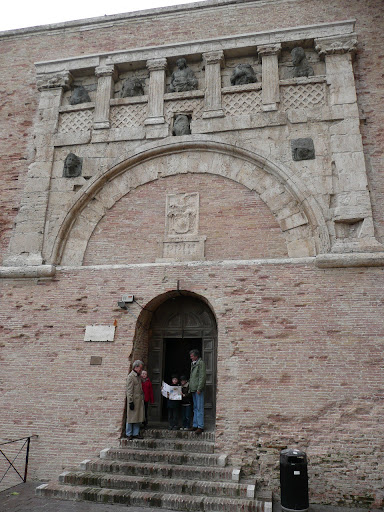
And the Romans ran with that just fine.


