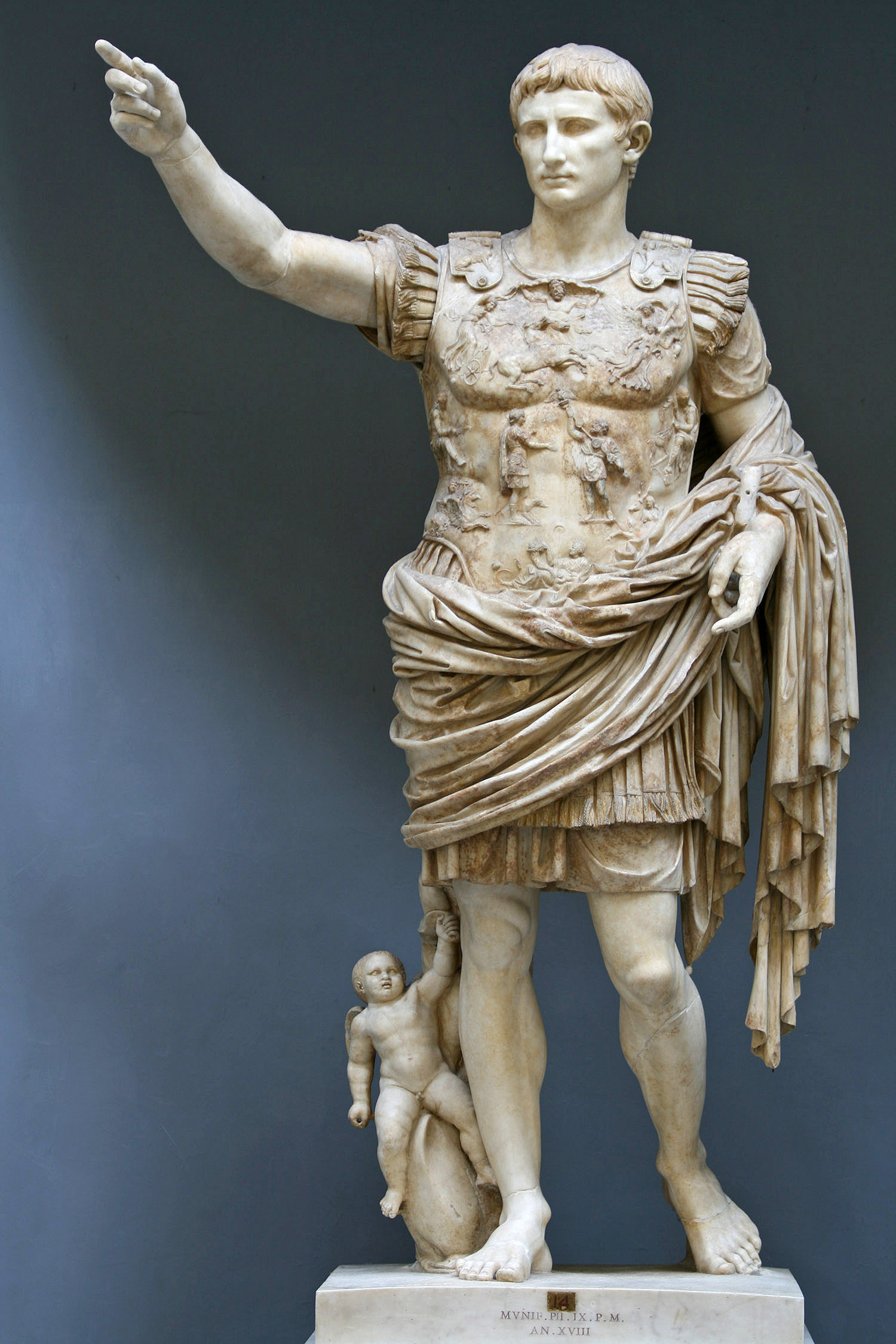
Emperor: All power and order emanates from me—-the heir of those who brought stability, and represented the valuable, the right and the good. I and my predecessors have succeeded. I represent the cosmos itself. I am the center of the universe, universal; the loci at which at forces combine and reenter the world. It bends to me. I am the patron to all. See the post on Domestic Art.
Now: One often tells the story of the growth of Rome and the growth of Christianity as two separate narratives. But it is only one. Power attempts to institutionalize itself, and uses legitimacy (derived from whichever source works best) as a tool to construct an image. I think it is no accident that as power concentrated in the office of emperor, a fringe developed. The stronger the message of universality, the stronger the opposing message. Several actors, one narrative.
Me: In my mind the story of the interplay between those two forces developed in the course of two epochs—the spread and strengthening of Rome to its greatest height under the emperor Vespasian, meanwhile the message of Christ's death and the coming kingdom of God, the writing that would record the story of Jesus and publicize this new religion to potential adherents. The second epoch would see the brutal and rigid maintenance of Roman rule, and the rapid spread of Christianity along the margins of Rome after the collapse of Jewish resistance and despite widespread persecution. At the end of the second epoch, when this story will end and a new one begins, Christianity will have so established itself that a point of no return had long been passed, the Roman empire enters a decades long crisis from which it will never recover, and cultural production enters an era of symbol, spirituality and abstraction entirely different from the art, literature, and philosophy of antiquity.
Me: The ultimately revolutionary manner by which the message and promotion of what was then still a reformed Judaism among myriad other pseudo-Judaic sects came from the man now known as St. Paul. St. Paul, originally a Jew called Saul, had begun his career amidst rather inauspicious beginnings relative to the Christian cause. He had worked as a bounty hunter for the Romans, hunting for and turning over to provincial authorities the committed followers of Jesus' teachings and believers in his apocalyptic, millenial message. After all, the Romans had killed Jesus as a criminal for his role as a subversive against Roman universality. Those who followed Jesus then only continued to propagate ideas counter to Roman aims the fact that the activity occurred in what one could easily consider as the most rebellious of Roman provinces made it all the more pressing to suppress such activities, no matter how innocuous they may have seemed from a Roman point of view. While on the way to Damascus, however, Saul underwent a spiritual conversion, and soon joined with the members of the Jesus movement, still on the run and many wavering in their faith, as one of Christianity's most zealous and effective promoters.
Now: This story has grown taller, bigger than me. But I've stopped fighting. I submit my body, I comply. Another kingdom awaits me, after all. And people there to listen, and I learn to listen to them. Order I'm a part of, order I make...an unordered beyond this world entirely. Take what you need from me, for I am a tool of God.
Me: Christianity, then, is the religion of those who lost. It's a religion of those, starting with its leader, of those left out, who had no hope of inclusion into the dominant system. And unlike Judaism, which at its roots sent a message that adherence to the laws would be met with rewards on earth, Christianity deviated wildly. It made no promise of reward in the here and now—rewards would come in a world and kingdom great than this one, after death, in heaven, at the end of the world. In that kingdom, the weak and the poor would be the masters, as a result of their belief in that true king and his dominion, and abiding by the precepts and virtues preached by that real power. It is thus a religion tailor made for the poor.
Instrument: I'm finishing writing this blog, and will write only prayers instead. I will write only prayers instead. Let's have a chat about history, ask me a question. I might know. What did I want after all?
Me: While the Christian church was still charting untravelled territory as the first century began, the Roman Empire upon the death of Domitian in 96 was about to enter its most illustrious and powerful years. What had in the first century been an expanding empire held together by brute force and the legitimacy that buttressed the emperors, though not his office. The Flavians had successfully suppressed the most heated Roman province as well as Egypt, had stabilized as economy rippling from new commerce and expanded trade, and pulled Rome out of a messy civil war. Thirty years under the Flavians, even though Domitian, held in ill repute by the historians of his time, is now seen by contemporary scholars as a stern and severe administrator who laid the groundwork for the prosperity that Rome was to enjoy for almost a century to follow under the leadership of a series of emperors known traditionally (a phrase first attributed to Macchiavelli) as the Five Good Emperors.
Me: In Rome, things had begun to gradually shift under the five good emperors. Whereas the Latin speaking western part of the empire remained the cradle of the system, the empire's source of fortune and wealth began to slowly shift to the east—to the bustling ports of the eastern mediterranean, Anatolia, and Alexandria in the Greek-speaking Eastern empire. More and more often events in the east took greater precedence for the emperors—although border conflicts continued in Britannia and Germany, the real commercial activity and valuable resources were in the Greek speaking half. [Not to mention, richer people, richer cities, and governors who controlled more and more of the resources that kept rome running. The administration was in the west, but the power, those who held the keys to the empire's wealth, were in the east]. This general shift remained only a problem of economic development for the emperors up through Marcus Aurelius, the stoic scholar emperor. It would, however, have grave consequences in the decades to come, as Rome would all but fall apart. In a process beginning with the emperorship of Commodus, the Roman empire would begin its decline from the greatest heights of power, a process that would leave Rome as it had been known for centuries forever changed, and laying the groundwork for the political, spiritual, and social foundations for the centuries to come.
Now: Little is left in the desert that Rome called peace. Products bought and sold, and pushes against power. Pushes against me. There is no kingdom under this, or order. There is a kingdom beyond, and I work among workers, as His instrument. I am free now.
Showing posts with label Rome. Show all posts
Showing posts with label Rome. Show all posts


10.09.2009
Introduction to the Historical Jesus
A few days ago, I saw the largest public mental health hospital in Argentina, which serves over a thousand inpatients from areas throughout the autonomous federal district of Buenos Aires. The building simultaneously looked as if it could crumble at any time and stand for another hundred years. A contradiction, maybe, but I got the sense that building had looked as it it was about to crumble for decades. What appeared to me as dilapidated would probably remain so--a great work of public financing, concrete and peeling paint, it seemed like a cross between an ancient English prison or public school and almost all the buildings I ever saw in Cuba. There was nothing beautiful or quaint about that place. It frightened me to approach it, frightened me to even look at it. It engaged me most of all in what it represented.
Nothing about the mental hospital indicated anything to me that suggested rehabilitation or care. I only saw something morose, neglected--marginalized. Certainly someone like myself, unfortunately well-versed in Foucault and postmodernism, needed no crumbling wall to assist in my own taught method of deconstruction. The place sits in the margins of the city, among warehouses and streets lined with prostitutes and transvestites. It wasn't inclined to therapy, certainly not treatment. It physically stood as a sign of power, of the state and a nation declaring what they wanted to become, in this case declaring what they would not have or accept.
So too, did I read the history of the Jews as they lived through the time when both myth and scholarship suppose Jesus to have lived, and bloody decades of revolt and open revolution that followed. The Jews had struggled under foreign kings for centuries, and struggled with all degrees of their leadership's usurpation by interlopers--the Babylonians, the Seleucids, the Hasmonians, the Romans. The priestly class would comply or collude, or not, or some degree in between. Revolts of all kinds, most famously under the Maccabees, challenged the kingdom that ruled the Jews, in an attempt to create the kingdom prescribed by their religion, and that promised to them by God to which their myths had declared them entitled. Those same traditions declared that they should fight to assure that their kingdom would remain theirs, ruled according to the order that God's laws declared.
I am certain that this synopsis does not properly give due to the history of the Jews. I now write for the second time on the Jews with this post, and I know enough to know one could do a project like the one to which I have applied myself on their story and beliefs alone. Maybe later. Nonetheless, I do no intend here to give a thorough treatment of the Jews and their history. Only to know enough so that I might properly situate the items I would put on my list, those which continue to influence today's world--the Gospels, and the New Testament written to promote the church of new religion of St. Paul and St. Peter.
The story of the Historical Jesus, and the story of the early church and the documents it would produce to me speak almost entirely of power. Jesus's followers would reread Jewish traditional text in a manner that would ultimately become a religion of its own. For a time, though, when the Jewish kingdom fell into chaos and uncertainty over its own future, what would become Christianity would almost become the future of Judaism itself.
Regardless, though, of what may have happened, Christianity departed from all other religions. However, it maintained certain similarities, directly or not, to Greek and Roman schools of thought like Stoicism and Platonism--its revolutionary change lied in its relationship with and departure from societal order, control and governance of the day. The kingdom on earth paled in its majesty to the new idea of a Kingdom of God, not achieved here on earth but acting as a model, and those who sought to promote it here in this deceptive earthly world would surely live well in a higher one encountered only after death, reigned over by the creator himself, the son he sent to communicate its existence, and the spirit within all of us to receive that message.
This understanding would require a new set of myths, though, and a new foundation from which this worldview would grow. Thus the gospels, altogether different from the Jesus that really existed. I will write again on the Historical Jesus and the world in which he lived, and again on the gospels and Paul and Peter's church. I have yet to face something so difficult to wrap my head around as the Historical Jesus and the rise of the Christian church.
4.07.2009
On Romans Being Brutish
Unfortunately in the process of writing about the Romans here, I think I’ve failed to really grapple with those aspects of Roman society that stand out to me the most. Little by little I’ve poked away at data points…approaching a new object oriented thinking (thinking about the list and the data used to describe each point, e.g. location, date, etc.) has, I think, distracted me from thinking aloud (in writing) about the larger themes that interested me most in the first place.
I think also part of the problem has been that some of the most characteristic traits of Roman society as a whole seem to fall outside of the purview of this project. By this, I mean that religion, superstition, and tradition dominate the thinking and actions of Romans. These anthropological bits and pieces are, sadly, outside of what I can realistically grapple with in this project.
Despite these limitations, I still have room to think about those aspects of Roman society that intrigue me most. Or said more clearly, aspects of human behavior that I feel the Romans exemplify—the manner in which institutions and socialization operate in human psychology and the creation of value and purpose at the loci of power. Watching Rome made me think a lot about that, and I was able to grapple with those issues a little in my post about the politics of domesticity and Pompeii, as well as my fascination with Augustus. Art in Rome has illustrated the how values emanate from power centers more than any other medium that I’ve discussed.
Two new points of data that deal less with these lofty bits and pieces and more with the thinking of day-to-day Romans are novels in Latin: Petronius’s Satyricon and Apuleius’s Metamorphoses or The Golden Ass. Satyricon (on which Fellini based his famous film of the same name, shown above) is a risqué narrative of the misadventures of everyday, brutish and sexually charged Roman plebeians. It paints a good picture of everyday life and language at that time and place. The Golden Ass follows a somewhat classic Roman literary premise that draws a great deal on Menander and New Comedy in its “lover finds lover, lover loses lover, lover refinds lover” structure. It also deals with some of the things I’m really interested in by dealing with form, transformation, and operating on the margins of society. These both make the list.
The historical Jesus next time.
2.18.2009
Literature in Rome, and Vice-ey Verse-ey
What effect does nationalism, as one would understand it in a contemporary setting, have on the cultural production within the society where it operates? Does patronage of the arts via state sponsorship necessarily entail a political motive on the part of those deciding where to spend public money? What are the ways in which those in the political sphere can utilize creative production for its own ends?
Catallus, Horace, and Virgil are the next data points to appear on the list. I used my Great Authors of the Western Literary Tradition as my source for these. Much was made in the lectures of the civil wars that wracked Rome during Cicero's lifetime and well beyond. Understandably, based on what I've learned about the period. More interestingly, I think, is the revolution in society that Augustus's tenure as emperor brought about, and its impact throughout the century that followed.
I find Catallus and the neoteric poets elitist and self-absorbed, but that's why they are so obvious with regards to the period in which they wrote. Horace is forgetable in terms of his social impact. Virgil is incredibly important, but co-opted entirely by a state attempting to restore traditional values and create stability.
As for Ovid, well, Ovid and I are getting married. I will write more about Ovid in another post.
1.13.2009
Art and Philosophy in Rome, Part II
Pompeii and the Roman Villa, now on display at the National Gallery of Art, displays an impressive abundance of antiquities in a city built on the classical tradition. Washington D.C. lacks a sizeable permanent antiquities collection of its own (Dumbarton Oaks comes close, but focuses largely on Byzantine era antiquities and is downright cute in its size), so I anticipated the show as a rare treat at observing something classical in my hometown. I did so twice: the first time out of excitement, and the second time out of defiance. My friend Tyler Green, writer of Modern Art Notes, had heard through the grapevine that the show was poorly curated and told me so before I visited. As a lover of all things classical, I didn't want to believe it. But sometimes one just has to face facts. Despite so much good stuff on such an oft studied topic, I thought Pompeii and the Roman Villa was junk. Where did they go wrong? Did the staff overreach? Organize poorly? Miss the point of a museum's existence in virtually all of the material they presented? All of the above, I say.
Drawn largely from collections in Naples and the surrounding region of Campania, home to Herculaneum and Pompeii (of volcanic destruction fame), the exhibition focuses on the Republican and Imperial Roman decorative arts of the seaside villas around the Bay of Naples. The premise for the show itself is a good one...the domestic art and architecture of the Roman elite. It's a fascinating subject in its own right, as it touches on many of the subjects related to memorializing one's pedigree (which I touched on in my last post on Roman art, here), as well as showing the infinitely more political side of Roman life. That's right, more political side. Monumental architecture so known and loved (and about which I'll write more in the future), sought to commemorate the victories of Rome's sundry senators, generals, and emperors. It deified them, and shrouded them with symbolism that would resonate in the mind of the cadres of uneducated plebes who would be compelled to fight, either in the army or in riots, to further the political ends of the state leadership. Monumental art is just public oratory in shapes and forms, with a premise and pursuit.
Domestic art is certainly not without pursuit. It's just more crafty about it, like wearing your nicest suit to the interview, or buying a new dress for a gala. It's about appearances to those whom you hope might propel you or your family higher on the social hierarchy, or increase your wealth through marriage or the umpteen other kinds of alliance that manifest in the sphere of politics. These are the people impressed not by the giant triumph built near the forum, but by the title of the man for whom it was built, and what a closer social proximity to that man could do for them. Most striking to me, villa life seemed most of all the domain of femininity, where women became as powerful political operators as their male counterparts, leveraging traditional social norms like child bearing and arranged marriage, social visits and adornments for the family's political and commercial pursuits. I'm reminded of Catherine Allgor's Parlor Politics, in which the author describes how Washington itself was built by precisely this kind of political domesticity.
This was the place of otium, or leisure, as opposed to negotium, or work and business. Wealthy Romans from as early as the 2nd century BCE, still 100 years before the fall of the Republic, would build lavish summer homes around the Bay of Naples. This convention continued once Augustus came to power as Emperor, and for years after until the eruption of Vesuvius in 79 CE, which buried Pompeii and Herculaneum and have since turned them into the stuff of legends. Surrounding areas also became major trading ports, bringing money into the area from Mediterranean trade in grain from Egypt and other newly acquired Roman lands. Propelled by so much wealth, the seaside villas serve as fabulous exemplars of what art in this sphere. It communicates above all the values of those commissioning it, importing it, and buying it, and what they wanted to express by showing it off at home to guests. These are some of the finest art works at the highest level of craftsmanship available at the time, and as a text is rich with information about the society that possessed and financed them.
Examples of this context abound in Pompeii and the Roman Villa. Iconography from Egypt and Greece demonstrate the diversity of stylistic influences present among the Roman upper classes, but in a funny way, turning noted statues of gods and nymphs into candle holders and tray bearers. Mosaics of gardens, dinner parties, and Plato express a desire to create a particular mood. Paintings of the villas, to be displayed in the homes they represent, communicate a sense of pride and ownership, and capture an unspoiled moment in time, an escape.
So how does one reconcile these depictions with the idea that this was the sphere of real politics? Certainly it wasn't all black and white, nor can we characterize anyone as a single-minded political machine. But in the villas, this was leisure time...this was where one showed what he or she thought was beautiful (or thought was supposed to be beautiful), or revered, or special. I think it's most likely that those who actually enjoyed these leisure activities did have an opportunity to pursue them, and those who really didn't got to act like they did. I found the figurative depictions of scrolls, writing implements, and scrolls, especially remarkable...this was where one came for his or her own edification--moral improvement, if you will, outside of the dastardly goings-on of the capital city. Or at least showed you did. I like the mosaic of Plato with his students at the academy and the bust of Homer most of all with regards to this point. Most impressive were the consistent portrayals of Dionysos, the Greek god of wine and merrymaking. This is where you came to cut loose with friends, drink too much wine, have parties and meet people. Not the politic cocktail reception, but the drinks at the bar after hours. Rome was a peculiar place when it came to religion--there were any number of gods that one could worship, and the metaphysical realm was hardly an exclusive club. Almost all of them were accepted into the fold, and as long as one gave proper respect to the gods associated with the state, one could worship whomever he or she wanted...Mithras, Isis, Dionysos. Whatever. Leisure time provided ample opportunity for this sort of spiritual pursuit...especially for those committed to our friend Dionysos.
I'm sure at this point, after so much glowing about the material the exhibition features, the reader wonders why I would be so hard on the curating of the exhibition itself. The first time I visited was before the public opening of the exhibition, reserved for National Gallery of Art donors, which I entered by using my old employer's name. We started with a lecture by the curator herself, which was an excellent introduction into the premise of the show. But after it was over, and we entered the exhibition, I was stunned by how...dumb it all was. The context given in the works' presentation was misguided, favoring the place and the fanciness over the actual historical context. It left me feeling that I should revere this stuff just because it was Roman and old. I walked through feeling that the work there had all been done a disservice, treated as marginal Roman art, less interesting than the monumental architecture scattered about Rome or the famous busts at the MFA in Boston or the Metropolitan Museum of Art in New York, and that this was just a hodgepodge of hand me downs that the NGA could manage to cluster together. This, as the preceding paragraphs suggest, is not in any way the case. Instead, they played to the crowd, and I found it base. I visited a second time, thinking that another viewing where I could spend more time with the work would be helpful. I left irked again, miffed like a scolded child at trying to understand things that were beyond me.
Curating, in my mind, should be a rubric of value. It should be a guide to says here's why this was valued then, here's why people have valued it through the ages, and then asks, now what value do you find in it? And although I hate to prove him right (this out of sheer defiant pride), Tyler was right when I first discussed the show with him, and he told me the reason behind the rumors that it was crap...no curating. This show was the work of an arts scholar, who gave a fantastic lecture but couldn't put it together in a show. She couldn't find that common vein, instead leaving these valuable pieces in that b.s. wasteland where a lot of fine art and antiquities are placed...for rich people to feel cultured, to revere old stuff just for the sake of being old, for being Roman or Greek. I imagine curating in the antiquities is a very tough job, trying to present art for an audience for whom that art was not produced, and who ultimately have an exceptionally different worldview that is probably impossible to really understand. And the vehicle for interfacing between the works and contemporary audiences, the mystique of Pompeii through the centuries, was astoundingly boring, out of place, and made the whole thing feel disjointed. Specifically, here's what I think they did wrong:
- Overreached: The curatorial staff should've taken everything out of the show that wasn't explicitly an object of antiquity. That stuff about the eruption of Vesuvius, the 19th century oil paintings of its eruption, and the attempts to copy those antiquities in later years was awful. They had plenty there to make an exceptional exhibition, and I think they added the other sections to make it more "current" or "timely". The last two parts, one of which featuring representations of the explosion of Vesuvius and the excavation, and another a painting by Sir Lawrence Alma-Tadema depicting a sculpture garden (displaying alongside it many of the sculptures he painted), were the worst parts of the show, and must have taken a ton of time and money for all the necessary loans.
- Organized Poorly: All the bells and whistles added to the works to make the garden party theme more believable still didn't save it. According to the NGA's press release on Pompeii and the Roman Villa, the show is divided into five parts (this is news to me, as it is only vaguely alluded to in the brochure): "Patrons at Home", "Courtyards and Gardens", "Moregine" (the site near Pompeii where the frescos this section displays were discovered), "The Legacy of Greece", and "Rediscovery and Reinvention". This organization pained me--as a result of it, everything felt mismatched. Wall text seemed totally out of context or forced, especially in an environment were anything depicting myth got thrown in with "Greek Influence".
- Missed the Point of a Museum's Existence: I go to a museum to be able to engage as I please with some pieces, skip others, and spend ages staring at just a few. I know in a visiting exhibition, as opposed to a permanent collection spread, the intent is a little different. Everything just felt so Disneyland though, and it actually read to me like an academic's first foray into public history or art presentation, as if she felt like it had to be dumbed down to get the masses to appreciate and enjoy it. I know that the NGA can put on a first rate show that makes you feel smarter for having seen it and considered it. But in the end, this asked no questions of me...just put several objects together to fit the research that Matusch has been doing for years. Start with the art, not with the academic paper.
I'm pleased that I got to see all these works, I really am. But I'm disappointed with how it was presented. Ultimately, I felt that Pompeii and the Roman Villa just buttressed prevailing images of Greece and Rome, cordoning off these critical times in Western intellectual and cultural history as something we're supposed to learn about and supposed to appreciate, but by the time we're done we just want to go home. With so few antiquities in Washington, and so much legacy here that draws on precisely that tradition, I gave a sigh reserved from a huge missed opportunity. I guess there's always Dumbarton Oaks, and Baltimore is just up the road...
1.08.2009
Art and Philosophy in Rome, Part I
When I started this project, and the blog you read now that chronicles its progress, my intent was largely to be able to stick it to people. To know something about what people were talking about and maybe maybe maybe prove them wrong in conversation, hopefully in front of many others. I'm a total jerk, and I lack a great deal of self confidence.
In all seriousness, I've intended to give myself something of a cultural appreciation course. Although I've gotten a great deal out of the methodological aspects associated with research and theory, ultimately this has been an endeavor to know what the hell people are talking about when they mention Degas or the Byzantines...stuff that, despite years and years of school, I just seemed to have missed. An intended, but not anticipated, side effect of this was to find the chinks in the armor, and to filter the text given to me by the media of my own time through a paradigm of simple facts. In the case Pompeii and the Roman Villa, on display at the National Gallery of Art until March 22, I saw both sides of this pursuit--seeing and enjoying the physical objects that I had studied only in pictures, and being horribly disappointed with the curating (chinks on all sides...). So I get a third effect after all, that of beginning to really understand what makes a well curated exhibition and what doesn't. This series of posts will explore the exhibition in question and the art that it shows, in addition to giving me a much need opportunity to discuss the philosophical climate of Rome at the end of the millennium and through the first century. Hopefully, I'll manage to paint an adequate enough portrait of the worldview of the Roman ruling and creative classes along the way, and lay some groundwork for Roman literature and rhetoric. Next, Pompeii and the Roman Villa...
1.02.2009
Cato, History, and the Illusion of Conservativism
I often think of Cato these days when considering the Romans. Now that I too have lost pretty much of all hope in achieving the ideal that I once thought meant something, I think I can sympathize with him a little bit. Cato was a Roman senator, tough as nails apparently and a “real Roman”. Perhaps the most salient reason that I think about him lately is the motif he seems to represent. Horribly distrustful of the growing influence of Greek culture on Roman society, Cato called for a return to true Roman values. He believed they’d been disintegrating as a result of laziness and frivolity among the Roman upper classes. He blamed, among other things, the introduction of Greek thinking, carried on the back of Greek art, music, and philosophy, to Roman society
I note this because it seems that as the Romans approach the age of Augustus, the literature and poetry of Rome communicates a growing conflict that reflects Cato’s complaint. This is so at least among those lyricists and writers receiving the patronage (or disapproval) of Augustus and his chief arts liaison, Maecenas, and from a broader perspective among the political and societal programs of Augustus himself. By legislating and promoting certain societal values, Rome’s first emperor Augustus sought to recreate Rome according to an image, real or not, of time centuries before. This was the Rome of the Punic Wars, wherein Rome defeated the Carthaginians to the west (mid-third to mid-second centuries BC); the Macedonian Wars, fought at the same time as the Punic Wars and consequently knocking out every single Alexandrian kingdom to the east (with the exception of Egypt, which would fall under Roman control with the death of Cleopatra and the battle of Actium in 32 B.C.), and decimated the Gauls led by Vercingetorix to the north (this was Julius Caesar’s great achievement, called the Gallic Wars).
To be frank, I couldn’t care less about military history—tactics and generals, and so on and so forth. That stuff's for geeks and old men. My interest in these battles is understanding the heroes of Rome, and seeing the process by which Rome came to dominate the Mediterranean basin and what is now southern Europe and the Iberian peninsula. Furthermore, I wonder—how did a pseudo-democratic society manage such an expansion, and what tools did they use to effectively impose Roman control on regions so far away from the metropolis? Most critical to my study of these times is to see how cultural production reflects the societal dynamics put in motion by these events, and what kind of cultural identity resulted from them. Militaristic, certainly…but not just savage. This was a military controlled by the senate, a body whose norms and rules had been established over centuries. Rome’s successes—the glory of Rome, as it were—came to form the legend that would provide a basis for Roman patriotism, a critical component of Roman identity (given how dispersed Rome’s empire became, ethnic identity seems only a vague contributor to culture. Pedigree, however, is a different story. See my last post). The system that enabled these achievements, and the values that system socialized into those under its purview, would be just as critical to the identity, then, as the successes themselves.
Hence Cato’s complaint. As Rome becomes richer and more powerful, absorbing other cultures into its fold, the Greek civilization becomes one of the most popular societies of the past that Roman upper classes emulate. Art pieces are imported and copied constantly, and there’s a renewed interest in the writing, music, and philosophy of Rome’s Mediterranean neighbors. As noted in my last post, Rome did not just become Greek culturally. They took Greece and its products. The underlying dynamic of that process is one of the most characteristic components of Roman culture. And Cato hated it. He thought that Rome was losing sight of those values that had made them great, values that essentially made emulating Greece possible in the first place. Furthermore, he blamed a loss of patriotism for the greed that propelled the great Roman civil war forward that led to the rise and fall of Julius Caesar. He wouldn’t live to see defeats of Marc Antony and Brutus, and the eventual foundation of the Roman Empire under Augustus.
So what was for centuries a powerful Republic began to get shaky, and allowed for the eventual success of dictatorship (Don’t even think of making comparisons to the present—those conversations are so boring. If anything, look just at organizational dynamics. The United States is nothing like Rome, and doesn’t even approach the hegemony that Rome enjoyed. That is the first, and false, assumption made by those that compare the United States to Rome.) I was able in my last posts to show some of the culture that came out of Rome in the second and third centuries BC, right when Greece was on the wane and the Alexandrian kingdoms emerged. Now we enter a new era…the Roman Republic becomes pretty much the only game in town, and has swallowed up a bunch of other civilizations in the process. What does the last century of the Roman Republic look like? What were people thinking once Augustus came to poweer, and how does culture operate as a "technology of power"? How does understanding the context discussed above help to see the place of writers like Catallus, Horace, Virgil, and Ovid? What the heck was Cicero talking about, and how did philosophical schools like the Stoics and Epicureans come to dominate Roman philosophical thinking? Those are in the posts to come…posts that will be much richer as I understand what Romans like Cato and Augustus believed they lost, and wanted to get back to, and why we still read the things we do (answer: Virgil and Horace were on the Imperial payroll. Ovid was not by the time the Metamorphoses was written, making a cut and dry thesis on patronage a little difficult). And what the hell is a Christian, anyway?
For this post, I’m adding the extant parts of Livy’s history of the Roman Republic, From the Foundations of the City, to the list. Livy’s history covers several centuries of republican history, much like Herodotus’s Histories. Livy’s is interesting, though, because it’s written in a rhetorical, and thus somewhat persuasive style. His intent? Very much in line with what I’ve discussed in this post…he is forthright about his desire to demonstrate that the morals of Rome in his own time (59 BC through 17 AD) had degraded, and that everyone had to get back to the moral code on which Rome was based. His story that best encapsulates this commitment is the famous story of the Rape of Lucretia, in which sexual assault against the protagonist leads to the punishment of the man who did it and the eventual overthrow of the Etruscan kings and the establishment of the Roman Republic. Lucretia herself commits suicide, not because she is dishonored, but because she doesn’t want unchaste women in the future to ever have the option of lying about being raped as a cover for their adultery. Intense.
12.18.2008
New Notes on Republican and Early Imperial Roman Art
Taking some time to really consider the Romans relative to their Mediterranean predecessors has revealed some things to me about Rome, art, and the limits of my own method. Although at first seeming to be a culturally inferior environment for the arts in terms of its sophistication and originality, the art of Rome tells a story wildly different than that which one finds amongst the Greeks. The tools and methods may be hold-overs from another time, buthe values of the Romans, coupled with an ambitious technical know-how, make for a lot of rich material to think about. The consideration of that story though has yet again illustrated to me the limitations of the approach I utilize in this project, and I still struggle against my own dissatisfied internal critic that doesn't want to let me get away with such a general, paradigmatic view of things...


Part one of the Roman art story, and by extension of the society itself, seems to read psychologically raw--competition, alliances, and image. Art, as I suppose it always has, is a communicative form, but for the Romans it seems like its a medium reserved for a certain kind of message about the subject of the work or the guy who paid for it (usually the same thing). What I find particularly cool is all the figurative work of people in Roman art and their association with family pedigree, virtue and piety. I especially love the plethora of busts that abound of men and women, largely because I love seeing representations of the body used for reasons other than their function. The picture of the "togate male", dating from the late first century BCE, is one of my favorites...he's older, more contemplative, and carries on, both literally and figuratively, the tradition of his ancestral predecessors. His own seniority and experience are made obvious by his age and the piety he shows by bringing his ancestors into it, and by the simple fact that a sculpture was made of him. I can't wait to dig more into the concepts of virtue and piety in later posts.
Note here also the talent of the sculptor to make this a stable sculpture...a pedestal to the man's right, and the toga reaching to the floor mask the wooden trusses likely found underneath the marble finish. Not to mention the details and the somewhat posed position of the man's posture. Compare to Augustus of Primaporta, who's in a modified contraposto, with the strut masked by the little baby Eros at his right leg (I will dig further into representations of Augustus in later posts. There's a lot to say on that).
The display of piety is certainly not limited to the ruling classes, either. See the relief sculpture here, in which to freed and married slaves show homage to their former master in the middle. Do they treat him as their adopted father, in the absence of real parents? Do they become part of his household, and show piety to the tradition therein?
Other bits and pieces from Rome's material culture tell a similar story. Bits and pieces indeed...observe the Ara Pacis Augustae, the Column of Trajan, the Arch of Titus...built to commemorate and glorify the achievements, even the fulfillment of a supernatural destiny, of the emperors of Rome, thus solidifying the form of government and placing the rulers at the levels of the gods. An old trick, to be sure, and a well used one since then. In addition, these monumental artifacts don't only tell a story about the society that produced them, they tell a story through the relief sculptures all over them. A narrative unfolds, telling the major events, the key players, and victories of huge battles in which the emperors emerge victorious and further glorify Rome.
The monumental architecture seems to be just as productive in terms of legitimating the ruling class, building "vulgar" theaters or coliseums to satisfy the masses, or erecting enormous temples to illustrate their commitment to the gods of their society (Roman religion, and Greek to a lesser extent, is something that I still don't feel like I have much of a handle on). Then again, as in the case of Pompey, the guy just really liked theater, and maybe he just wanted one. Or maybe those who financed the large temples to the Gods felt they actually owed something to a higher power, or wanted people to be more religious and contemplative. Certainly I can't speculate so one-sidedly as to everyone's intent. People just aren't that one-dimensional...are they? In all these cases, none the less, the innovative use of engineering technologies like arches and concrete made possible structures far greater in scale and stability than had been seen previously. I still find scale like that impressive.
This "glory of Rome" idea confounds me though. Is it like the commitment to the city-state and the polis, through participation and democratic process, in some parts of Greece? Or is it a patriotic ideal, sort of like how people (but certainly not me....er...) believe patriotism works now, getting people to fight and die for the expansion of the empire and the further buttressing of the ruling class that runs it (Republican Patriotism)? Now we're getting into some fantastically challenging concepts, like honor, piety, virtue, glory, etc.....
Perhaps the glory of Rome, though, is tied into my last point...I think the wealth of Greek statues and Greek copies says as much about Rome if totally original works had as well. Janson's calls it syncretism, a word I find perfectly fitting. This was a grand empire, in competition with no one. Following the age of intense competition throughout the Hellenistic era, when nothing seemed certain and no one's rule seemed safe, to have such a lasting society, in which no force could muster the strength to even make a sizable dent for centuries, must have been remarkable. Truly, only few had done so up to that time in the world's history, and even since. Like any empire, they seem to have had few things which were truly theirs, except for their own power and societal structure (enter piety, virtue, tradition...) The ruling classes had a near mania for antiquities from Greece and, to a lesser extent, Egypt, seems rather fitting as Rome took on the self-proclaimed role of torch bearer of civilization and human productivity. Funny, though, how civilization works, as Rome and its leaders likened themselves to other civilizations and leaders of the past, as if by further proof of their own important role in the grand design of things. See, the Pantheon.
10.13.2008
The Etruscans and Emerging Italian Peninsula
Studying the Etruscans has reminded me of another time this project. Prior to the Greeks, I spent a while on the various tribes of Mespotamia and early Mediterranean civilizations (e.g., the Phoenicians, the Minoans…). I feel like I’m doing that again—laying the groundwork for the next shift in power, away from the Aegean to Rome. After all, the Etruscans were just another Italic tribe. I think the Etruscans are known to us in particular because of their well-preserved art and for the conquerors, the up-and-coming, mixed nation tribe centered in the city of Rome.
What’s important for me to note is a lesson I can take with me as I encounter new nations that the Canon encounters in its forward movement (e.g., the Celts, the Cossacks, the Gauls, etc.) These are distinct nations with equally distinct cultures, very much rooted in the realities and circumstances of their respective times and places. With luck, they add a little something of their own to the Canon or become insular enough to escape co-optation and disintegration under foreign rule (see Roma). If unlucky, they fade away into the legend bin of conquered peoples (see Carthage).
The Canon, the list—that culture without a place. It’s a juggernaut. Domination and it have a productive, two-way relationship, and have scratched each others’ backs for millennia.
The Etruscans are among those who managed to add something to the Canon. The Romans carried with them Etruscan sensibilities and religious trappings (by the time the Romans emerged, the Etruscans practiced an amalgam of Greek religion and their own inherited forms of fortune telling and superstition). The art that remains with us gives a glimpse of a society that, although never confederating beyond a series of city-states, had a unique set of cultural practices and history.
Where did they come from, and what was their source? Herodotus suggests Lydia (incredible article here about that), which has some evidence. Indo-European or Phoenician seems equally plausible and a bit more fun to me. They have so much in common with the Greeks of Antiquity and before, with their own regional spin, that there’s something shared there.
In sculpture and decorative arts, we see some differences, but not many. The Etruscans were fantastic metalworkers, and their methods of filigree and granulation still confound scholars. In sculpture, the distance between the cultures is slimmer, although important differences represent the enormous impact that available materials can have on art. Compare these statues:


Similar form, but more gesture in the Etruscan. Whereas the Greeks used marble for sculpture, the Etruscans used terra cotta, a material that allowed for much greater experimentation with movement and creating detail in faces. Many works also show the same Orientalizing and Egyptian influence seen in the Greeks as well.
Despite these similarities, I have to ask myself, what did they add? Therein do I get the real perspective on the Etruscans. It seems likely to me that, at least as far as art is concerned, the Etruscans and Greeks of antiquity shared the same source material, the product most probably of significant cultural sharing as a result of trade networks. But as much as I like to read into the text that aesthetics represent, ultimately I think these are just fashionable stylings, stretched out over centuries. The Greeks themselves didn’t really create anything original until the 5th century, and that work was influenced by a major shift in how artisans thought about their work—an artistic commitment rooted in new ideas about the world. I doubt few of the values of the Greeks and Etruscans had much in common at all. As for the transmission of ideas were concerned, the Etruscans and other Italic people were their own men and women with their own assumptions and beliefs. They shared a vehicle of expression with the Greeks, and that’s all. Those contributed to the formation of the Roman people, not the aesthetic sensibility alone. And I’ll just have to see what that really means when I get on with the Romans themselves.
One thing I can peg now on an Etruscan to Roman link. They gave them the arch:
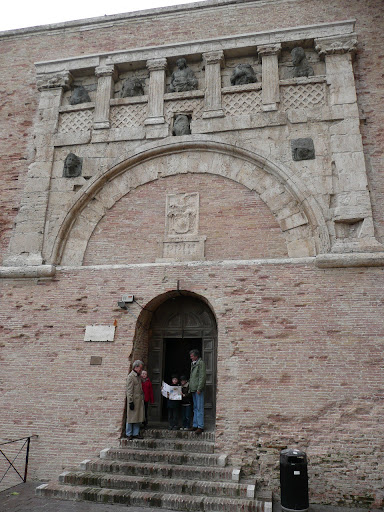
And the Romans ran with that just fine.

What’s important for me to note is a lesson I can take with me as I encounter new nations that the Canon encounters in its forward movement (e.g., the Celts, the Cossacks, the Gauls, etc.) These are distinct nations with equally distinct cultures, very much rooted in the realities and circumstances of their respective times and places. With luck, they add a little something of their own to the Canon or become insular enough to escape co-optation and disintegration under foreign rule (see Roma). If unlucky, they fade away into the legend bin of conquered peoples (see Carthage).
The Canon, the list—that culture without a place. It’s a juggernaut. Domination and it have a productive, two-way relationship, and have scratched each others’ backs for millennia.
The Etruscans are among those who managed to add something to the Canon. The Romans carried with them Etruscan sensibilities and religious trappings (by the time the Romans emerged, the Etruscans practiced an amalgam of Greek religion and their own inherited forms of fortune telling and superstition). The art that remains with us gives a glimpse of a society that, although never confederating beyond a series of city-states, had a unique set of cultural practices and history.
Where did they come from, and what was their source? Herodotus suggests Lydia (incredible article here about that), which has some evidence. Indo-European or Phoenician seems equally plausible and a bit more fun to me. They have so much in common with the Greeks of Antiquity and before, with their own regional spin, that there’s something shared there.
In sculpture and decorative arts, we see some differences, but not many. The Etruscans were fantastic metalworkers, and their methods of filigree and granulation still confound scholars. In sculpture, the distance between the cultures is slimmer, although important differences represent the enormous impact that available materials can have on art. Compare these statues:


Similar form, but more gesture in the Etruscan. Whereas the Greeks used marble for sculpture, the Etruscans used terra cotta, a material that allowed for much greater experimentation with movement and creating detail in faces. Many works also show the same Orientalizing and Egyptian influence seen in the Greeks as well.
Despite these similarities, I have to ask myself, what did they add? Therein do I get the real perspective on the Etruscans. It seems likely to me that, at least as far as art is concerned, the Etruscans and Greeks of antiquity shared the same source material, the product most probably of significant cultural sharing as a result of trade networks. But as much as I like to read into the text that aesthetics represent, ultimately I think these are just fashionable stylings, stretched out over centuries. The Greeks themselves didn’t really create anything original until the 5th century, and that work was influenced by a major shift in how artisans thought about their work—an artistic commitment rooted in new ideas about the world. I doubt few of the values of the Greeks and Etruscans had much in common at all. As for the transmission of ideas were concerned, the Etruscans and other Italic people were their own men and women with their own assumptions and beliefs. They shared a vehicle of expression with the Greeks, and that’s all. Those contributed to the formation of the Roman people, not the aesthetic sensibility alone. And I’ll just have to see what that really means when I get on with the Romans themselves.
One thing I can peg now on an Etruscan to Roman link. They gave them the arch:
And the Romans ran with that just fine.

Subscribe to:
Posts (Atom)