In a two part series to finish my exploration of the Greek body of text called Order/Disorder that I introduced in my last post, I discuss in two entries the basis of the moral code derived from a belief in a cosmic order, and the cultural production that resulted as adherence to that morality began to wane. Here, I build on the idea that order and logic provided the basis for Greek cultural and intellectual production throughout much of the Classical age, and suggest that this corresponds with the spread of Pythagoreanism.
The process of understanding Pythagoras has made the dynamic Greek civilization more understandable to me, especially as I’ve placed analyses by guys like Snell in a more informed historical context (It’s been very hard to find a discussion of Greek intellectual and cultural history that actually discussed sources). The Greek myths best known from the works attributed to the bard Homer had existed for centuries by the time Pythagoras appears in text in the early 6th century BCE, and a comparison of the two paradigms that the two aforementioned thinkers represent reveals the way in which thinking could open up, allowing for new perspectives of the self, the soul, and the nature of the physical world. The ancient Greek mythology that we all know and love relied on a set of assumption with only a very loose understanding of the body and what animates it, and believed in a pantheon of gods with all the caprices and brutality of human beings. Fate unfolds without any design, the threads of space knit together b
 y the blind almost by chance, and as the tapestry forms across time, gods and men act and react within the physical world we can perceive with the senses. Kosmos (order), on the other hand, has purpose. The world operates according to a larger system—objects in space are units that operate as part of the whole, each with a value defined by an overarching structure. It gives man a new power—the ability to know and predict. It also gives him a personal space and individual choice (the source of the concept for the soul, be it material or immaterial).
Pythagoras gets credit for being the first transmitter of this kind of thinking, which would have far reaching effects on the Greek body of text that unfolded over the centuries following his life. Certainly Pythagoras was not the first to suggest some greater order to the universe—not only had he received an education in Egyptian and Babylonian traditions, he also continued the ancient Greek tradition attributed to Orpheus and his cult and before that, Dionysus. However, the rise of Pythagoreanism (at present ignoring his possible sources), corresponds to the rise of a different way of thinking—the growth of the cult of Apollo (which ceases to see him, and the muses which follow him, as very human-like creatures—anthropomorphic—and more like the ideal being and keeper of the order and of its revelation), and the burgeoning prevalence in text of references to the self and the individual mystical experience, that ecstatic moment of awe and wonder at the world and one’s place in it.
The nitty-gritty of Pythagoreanism revolves around number—but not as we would think of it; certainly, it’s almost violent to consider putting as much faith as they in what the contemporary mainstream would consider coincidence. Pythagoreanism itself took me quite a while to wrap my head around, and I had to research a great deal (thank you to Christiane L. Joost-Gaugier’s excellent book Measuring Heaven for its analysis of the growth of the Pythagorean school and its impact on art from the Classical period through the Middle Ages). I even visited New York City just for the day to attend a philosophy chat to which I was invited at Logos Bookstore on the Upper East Side just to ask the publishers who were sponsoring it some questions about Pythagoras’s number theory and ethics.
Fundamentally, it requires a different concept of numbers altogether, one not of magnitude (like how many apples are in a barrel, times 8 barrels, etc.), but of limit and definition—points in the infinite which, when seen as a series, provide structure for and make sense of the vast indefinite. The analogy of the monochord pulled it together for me—like on a guitar, where one can push the
 string an infinite number of places to create a new tone, one must have a sense of proportion with the original string’s length to really develop a system of tones based on ratio. Although the units one would choose to make those ratios (3/4, 8/9), etc., may seem arbitrary in an absolute sense, when utilized consistently in a defined system it makes a perfectly logical operating system. Thus, number does not have value in and of itself, but only relative to other points in the system, regardless of whether that system is constrained on a line, on a surface, in space, and in time.
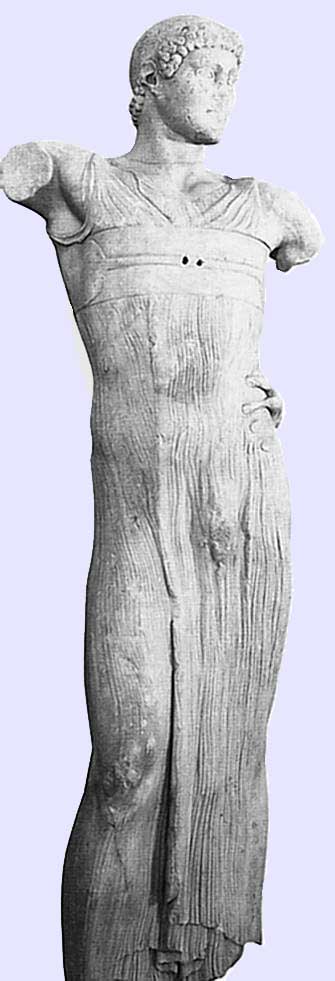
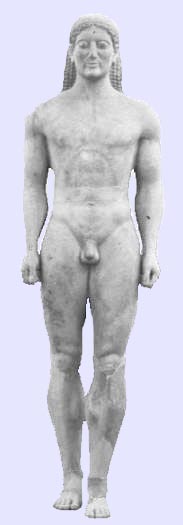
I know it seems kind of nutty, but its actually wildly fun to figure out and really throw yourself into—no longer seeing just components, but the entire system and its intended operation. The Pythagoreans believed that the existence of ratios at all was not the order itself, but simply evidence, a reflection, of the larger system and design to all planes of existence (there are myriad approaches to the questions that this perspective allows relative to the end point of this whole system, the place of the individual within it, and so on. Please see my Plato post for just a couple of these responses by the thinkers known as the Pre-Socratics and by Plato himself). And so much Greek cultural and intellectual production reflects this assumption…statues that take into account the entire human form in order to create the image of an ideal man; temples where every angle and span work together in order to create a structure that inspires a sense of awe and majesty; an oral argument that makes the listener dive into his very beliefs and come away from the speech thinking differently about himself and his society; a social structure whose sole purpose is the just, and the good, and the right.
 All these examples I list, though, hinge on a the creator’s commitment to a fundamental concept, and as I consider them it seems very clear to me how (certainly not why...that I'll explore later) the Greek text began to fall away from this manner of seeing artistic production into a world of disorder and confusion, as Greek civilization did by the early 3rd century BCE. The fundamental concept to which I refer is harmonia: the idea that the producer created a form of true beauty through its logical consistency, through its application of components whose value derived from a central rubric centered on the purpose of the form. Furthermore that the very purpose of creating the form was to coincide, or harmonize, with the greater order of existence. That is a question of morality—a commitment to the grand design by creating a system whose purpose worked toward that design’s intent. Thus it’s not a casting off of logic—certainly not—but a hazy idea of why one should use that logic at all. And that’s a matter of faith and personal purpose (I would suggest that the whole thing requires an initial inductive leap, but that’s because I’m an immoral person). As the Greeks discovered the power of a logical system, be it in music or oratory or art, many began to utilize it for their own personal gain instead of a moral code based on a concept of the universal order (see my post on rhetoric to read my own exploration of the philosophical problems caused by the work of the sophists, and a discussion of dialectic argument as a part of that inquiry). By the time Alexander rolls around in Greece, the body of text that we’ve inherited reflects a slowdown (although certainly not an end) to inquiry into the nature of order, and a greater priority given to functional knowledge created for the sake of application (See Euclid and Archimedes), without a coinciding discussion of the merit of the creator’s intent and the endpoint he or she pursues.
And so we see the philosophical discussion pushed to the edges in the new world of disorder. There, the schools and tribes of marginalized peoples who carried on the mystical traditions of the past would give birth to Stoicism, Skepticism, and of course, Christianity. Although Christianity will have to wait until the Italian peninsula and Rome, next post I’ll discuss Hellenistic literature, art, and other philosophical movements as I explore culture in a world of disorder.