The study of Greek drama has been one of the most rewarding scholarly experiences I have ever had in my life. How was I to know, anyway? That this discipline, this literary form, would lead to so many tangents and digressions, make me feel required to pursue a greater knowledge of such a diverse range of topics? How was I to know that the genre and the act has such a unique role in society and human creative production, that it is the amalgamation of all the social and artistic forces that came before it? I have entered a spinning tunnel much bigger than myself or that which my mind can grasp in my study of Greek drama…and here I thought this would be just another step in my methodological progression through my self-made curriculum. In learning about it, I have been forced to fully actualize my project; in learning about it, I have experienced that moment, that happy circumstance in which everything came together to elevate me to my own personal actualization, wherein I understood for a moment artistic production in the West, and felt like an artist myself just by studying that which I do. I met the limits and boundaries of my project, and really felt the furthest extent that I can venture without losing myself entirely into total digression.
I can comfortably contend that if one understands Greek drama, he or she can understand the civilization. Drama in Greece may not have all of the qualities of every creative product of the civilization from whence it originated, but a true understanding of it requires an understanding of everything else; its place, its moment. I can’t write some essay to bring it all together for drama as I have in the past. No, can’t is the wrong word—because I have more of a feeling about it then a sense of my own ability as a writer or scholar than the use of the word might imply. I don’t want to write some essay to bring it all together for drama as I have in the past. Nor do I think I’ll ever write such an essay again. I’m through with that style. So here I’ll give you some thoughts…no conclusions, or arguments even. Connections I’ve made that will form the basis of my understanding, a center that can be modified and altered in order to adapt to new information. These connections have their basis in that which I’ve learned, but I won’t bore you, and more importantly me, with presenting it all. I’ll give you ideas and logic, enough to show you where my connections come from. But we’re moving, from social science to philosophy, from control and end points to pursuit for its own sake.
Fundamentally, I distinguish drama as the only vehicle which expresses the feeling man has when he confronts the dominant order, and to a greater extent the anxiety and tension caused by disorder and the failure of distinct value systems to align at key points. Whereas varieties of verse (elegy, iambic, lyrical forms, didactic) can discuss an idea, express a feeling, or make an attempt at musical ordering through verse or rhythm, dramatic production incorporates all of the aforementioned aspects and puts them to the test of experience using its temporal and spatial element.
In addition, the public quality of drama affords it more special treatment by throwing opposing societal forces into the arena to fight it out. It becomes political because of its “shared” nature—audience and performers, chorus and playwright, enter public space and have a discussion, creating a moment’s discourse, a fleshing out of human experience according to the parameters of the day. It’s truly the second at which so many individuals, forces, and traditions come together.
Many threads wove into one another to become drama as the Greeks understood it. This basis suggests a version of the development of Greek society, and even the general principles of the dynamics of the network I’ve discussed in past posts. I have come to understand that mainstream Greek culture, that which we know from text, has no single set of values. Greek culture was turbulently dynamic and constantly changing. Like any other society, it was a stew of distinct value systems that existed in the same pot, occupying the same space and manifesting in text. Culture, and the web that constitutes it, is such a funny thing. Institutions and rituals are designed to reaffirm culture, and educate in its function. Changes come about constantly through mixing and conflict, reactions and responses follow, and the transmitters of culture (namely the institutions, power relationships, and rituals) morph and change as well. I have carried this premise with me throughout this project, and my recent study has served as a reaffirmation to this idea.
In the case of Greek civilization, two, major cultural traditions had a substantial impact on the dynamics responsible for mainstream textual production: that deriving from texts attributed to Homer and Hesiod, and that found for centuries throughout the Mediterranean, growing from roots in Egypt and the Fertile Crescent. My understanding of the development of mainstream Greek culture, and the production of the cultural texts we posses in our time from that civilization, conforms to the paradigm defined by the interplay between these two traditions, and the development of new institutional structures that grew out of both.
I associate the Egyptian/Mesopotamian tradition with fertility gods and primal urges like sexuality and blood lust. From these follow the rituals inherent in such practice. The Homeric/Hesiodic tradition, on the other hand, clearly dominated as the more institutionalized and subsequently more widely conceived of as legitimate within Greek society. Its cosmology relied heavily on the valuation and ordering of the outside world, which had only one physical plane that operated according to a single ordering principle. The very ideas of beauty and good themselves depended largely on how closely a work aligned with this order. The muses acted as the order’s keepers, with a muse for the major disciplines and the astrology that revealed to humans the origins of the order. Without an understanding of independent human action, the Greeks held that creative production came only when the muses showed humans a glimpse of the order, and passion came from divine intervention as the gods pulled the strings of our puppet bodies. In sum, both traditions, the Homeric and the Egyptian/Mesopotamian, had cosmological bases that reinforced ordering principles through ritual and tradition.
I believe that the development of the institution of drama in Greece, and more specifically tragedy, is the greatest illustration of the interplay between the Homeric and Mesopotamian traditions, and had its greatest resonance and importance to its society (perhaps a catalyst towards its development) during a period of transition into the Age of Reason. When we see drama, we see the meeting of these traditions, and a foundational element of the West. The worship of Dionysus gave rise to Greek drama, or at least its ceremonial roots, and as the god of fertility, worship of Dionysus kept alive the ancient Mesopotamian traditions. His festival, the City Dionysia, was a celebration that derived not from the dominant Homeric tradition, but came out of the legacy established by the traditions of the Mediterranean. Revelers paraded through the streets with giant phallic symbols, and entered trance like states, madness and drunkenness. The ceremonial dance, the dithyramb, was written and performed by competing troupes from the surrounding areas, who competed with chants in a form and meter of choral lyric distinct to this occasion.
The real cross between the two traditions came when the dithyrambs told Homeric myths in their chants. Greek drama itself was born when an individual stepped out of the group, speaking the lines of the main character of the story the chant told. In a distinct meter, he spoke his lines, and the dithyramb spoke in response. The dithyrambic stories became dramatizations of the ancient myths, saying how the protagonist could have felt, what he could have thought during the action of the story. Soon more actors (two) acted a variety of other parts, changing characters using a variety of masks, speaking to each other but acting to the chant of the chorus.
The transition between these data points of drama’s formation and the institutionalized tragedy competition remains a mystery, a hole that few would dare to try and fill. Tragedy provides a very specific kind of resonance using a particular kind of experience by the actors, and even a moment’s reflection on the leap Greek drama made illustrates how much the institution’s birth can confound. Tragedians competed annually at the City Dionysia with three original tragedies and a Satyr play, the ancient predecessor to burlesque. In these tragic stories, the playwright dramatizes the impact of a decision made by an individual. In the end, although the individual suffers for his mistake or decision, the story upholds the order which defines the individual’s decision as right or wrong. Thus a cosmic order prevails, providing a catharsis, or “cleansing,” for the viewer by making him believe that the system maintains its integrity. Comedy provides a cleansing as well, but in a different sense. It shows a dis-alignment between value systems, revaluing ideas from the world according to a different rubric, making seem funny or different because seen through a different lens. Thus another cleansing occurs.
Both these dramatic forms had their greatest resonance during periods of great transition and change, and I can see why: the era’s intellectual shifts cast doubt on the inherited morality. Tragedy shows the order which prevails, and although we must observe the downfall of an otherwise pathetic character, we see the struggle between right and wrong, and the playwright reveals that a universal morality persists. We see a clear delineation between value systems because of the vehicle that drama provides…clear cut, obvious clashes between rarified symbols of impulses, ideas, and possibilities. Real life confusion fades as the audience watches the consequences of great acts, and often the protagonist feels that their actions are worth a price they anticipate. But at least these choices and their consequences are clear…they are clear. It is a story that illustrates that the world has an order, whether it benefits us or not, and that order will see itself to its end result.
This distinction of the actors from the chorus, though, is crucial. The dithyramb voices the order, and the individual posits a viewpoint that calls that order into question. The result of the questioning will lead to the protagonist’s demise, and as the audience we feel the anxiety of the protagonist as he or she struggles with the decision and its consequences. It makes the audience consider what’s at stake, and the final outcome reorders and realigns the world by dispensing a cause and effect relationship according to one system of order or another.
When text makes us confront values, either by explicitly combating one set of values or understandings or assumptions with another, thus making us question the values of both sets ourselves, either by considering fairness, or by laughing out loud. We experience what the actors do…they make us feel, not by evoking per se, but by bringing us along in their experience. And if it’s really good, we don’t realize that the chorus or the characters were symbols of values or ideas all along, but simply components in a story in which we can lose ourselves. We go along, and feel the disalignment in the story and in our lives. We feel the questioning, we experience its results, and we are tired when it all ends.
We haven’t even discussed the development of the new ordering principle that made people doubt tradition and bring about such turbulence. Bertrand Russell argues that this principle, reason, never took over to become the new order, but created a duality with tradition that he believes defines the Western cultural heritage. In the middle of this conflict lives philosophy, and the experience of the individual. But I have many questions, specifically regarding the shift from an interplay between the Homeric and Mesopotamian traditions to the Age of Reason. Additionally, from whence did reason as an ordering principle derive, and what was the impact of its growth as a distinctive force during a period of transition? Did reason ever become the highest form of order in Greece, one that dictated the values in societal structure and personal achievement? Who was Socrates?
In other news I’ve learned a great deal about prosody and Greek literature in general, using guides on poetry and the classics as study material. And from here on out, you’ll see a more journalistic style in my posts, which I will write at regular intervals, updating you on my progress through subject x or y, not only at the end of my study of those subjects. At the same time, I’ll be writing non-persuasive essays to help me bring my thoughts together. I still plan on learning Greek, and reading this stuff in its original text so that I can fully appreciate this meter and even try to recreate it, fully appreciating it myself. I add dramas from the three great tragedians (Aeschylus, Sophocles, and Euripides) and a comedy from Aristophanes to my list. I also add something surprising—Hesiod’s Theogony, because although I have never read anything on it from my main secondary sources, I must acknowledge it as the beginning of didactic verse, and a fundamental text to the understanding of the Greeks. The project continues in the future with more political stuff, as I delve fully into the great historians and political writers—Herodotus, Thucydides, and Xenophon, and into the much tougher, and absolutely fundamental Plato and Aristotle.
But I’ve broken it open, you see…I’ve come to understand most of all the complexity, the boundlessness of this pursuit, and it’s wonderful. It’s time to stop limiting my own imagination by fooling myself into thinking that I can make some argument that will stand with only my cursory study of things. From here on, I experience this, I do not produce it. From here on, this is my truth and my art, and I will treat it as such. I’m owning this project. From here on, it’s mine. Furthermore, it’s me, and no one would dare to package themselves with such neat paradigms. My methodology stands, as do my priorities and the real foundation of this process. But now that’s largely done. I can move on, because this project has a life of its own, and I gladly lose myself in it, amidst wine and cigarette smoke, whenever possible. And to the project—as I noted you’ll see a different tone from me in the future…this takes on new meaning for me, it has become more actualized. Thanks for humoring me, and being a part of my life.
Showing posts with label Fertile Crescent. Show all posts
Showing posts with label Fertile Crescent. Show all posts
12.19.2007


6.10.2007
Primal Beginnings

I should pretend to write this in cuneiform. You know, envision a clay tablet perched in front of me, and a papyrus reed in my hand? The authenticity and general street cred it would provide…well, that’s the stuff of legends. Okay, Ancient Mesopotamia would have to fill the headliner spot. I get to be a roadie, at least.

This post details my plunge into the cultures of the Fertile Crescent (with the exception of the Hebrews—I’ll devote an entire post to them given the wealth of documentation from that culture). I devoted time to studying people like the Sumerians, the Babylonians, the Assyrians, the Hittites, etc., with the intent of knowing some background. To clarify, the civilizations that sprang forth from the region of the Eastern Mediterranean to the Tigris-Euphrates river valley provided the cultural beginnings of the Western World. I felt it appropriate to know the back story, and even more importantly to know the values and the themes, the questions, the narrative styles that sprang from the ziggurats and clay tablets and spread into the Mediterranean to influence other, more familiar cultures still in their nascent stages. Besides—it’s the Cradle of Civilization, right? My work on Mesopotamia draws from Janson’s, Mythology, and Great Authors. I’ve worked mostly to learn the basic history, but I’ve enjoyed discovering some consistent thematic strands in every medium.
History, literature, and art present so many challenges with regards to putting oneself into the place of both the documenter and the subject of the document. How can one not find an immense degree of difficulty in practicing this critical approach when applied to people and culture that existed two and a half or three thousand (or more) years ago? Sumerian mythology or an epic like Gilgamesh confound because one just can’t relate. Only by understanding the historical circumstances can one really get past the simple stories and truly give these works a think. I came up with some basic assumptions to aid my understanding. Some may seem obvious, but in context they took some time to sink in.
Power supersedes all in Mesopotamian life. This brutal struggle, this fight…some argue that human nature stops here, at power. Whether or not this rings true remains for me to explore, as I know the discussion on this matter will extend to examinations of the present day. This power, though, this…so much more brutal, so epic, even a dead sad. Sad, or fatalistic?
How can one not feel a defeated futility when the Gods are unquestionably the most capricious and jealous sons of bitches you’ve ever met? “Ever met” has a literal meaning in the case of the Mesopotamians—they lived in the temple on top of the ziggurat in your town. They reproduced. Other gods or even especially gifted humans could kill them. Baal and Ishtar and Marduk lived present within the community, and gods like these had say over the most fundamental aspects of survival—floods and weather, crop fertility, reproduction and human health. This brutal struggle for survival, which seems to unfold in a primal interplay between physical and sexual, bleeds into relationships between men.

Domination reigns in a world of vivid mortality, scarce resources, and apparent futility. Works of art like the Stele of Naram-Sin and the British Museum’s collection of Assyrian clay tablets depict crushing heroes, whose prowess and strength win them victory and super human and divinely mandated leadership status (maybe even claims of divinity itself). As for governance, most tout the Code of Hammurabi as the first system of law but only some accurately regard it as harsh and unyielding (“eye for an eye”), indicative of the reality of the period. This self-aggrandizement and social supremacy, although certainly not the sole characteristic of the Mesopotamian civilizations (or limited to their cultures alone, for the matter),  dominate their art and cultural production. In spite of this, the art of these millennia worth of culture created and exhibited an appreciation for beauty—lyric narratives like the epic of Gilgamesh, Mesopotamia’s visual and plastic arts, and poems like this possess their own artistic value. I suggest, I suppose, a connection between the primal behavior, the attitude toward the Gods, and fatalistic sadness in the attempt to create “order from the watery chaos”.
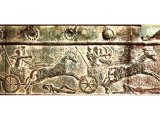 dominate their art and cultural production. In spite of this, the art of these millennia worth of culture created and exhibited an appreciation for beauty—lyric narratives like the epic of Gilgamesh, Mesopotamia’s visual and plastic arts, and poems like this possess their own artistic value. I suggest, I suppose, a connection between the primal behavior, the attitude toward the Gods, and fatalistic sadness in the attempt to create “order from the watery chaos”.
A quick note on Gilgamesh. I read this epic, with which I had an easy time at first, but upon has given me cause to reflect on it for a long time since finishing. Its story relates to the aforementioned scary themes of power and death. More profoundly, it has an underlying desperation and a weird, quiet search for answers. And in all of Mesopotamia’s narratives, the mythology and visually oriented works, one sees some fundamental questions with which we still grapple…What does it mean to be human? Self awareness defines itself relative to the world around the subject. The converse of that assertion, though, may resonate more with this period of cultural production—the nature of the world reveals and defines itself as a function of self awareness. Hence one explains the world with stories based on personal experience. This is why the literature and art of Mesopotamia profoundly illustrate the lived experience there. This query into human nature and the endeavor to explain or depict the world around us remains constant through to today as a part of a universal artistic commitment.
Coming up…a similar discussion of the tribe called the Hebrews or Israelites, and of the interpretations of the Old Testament. This topic ties closely into the discussion above, especially with regards to the overlaps in mythology and the appearance of Mesopotamian gods in the stories of a monotheistic culture. Then onto the Greeks and the real stuff of this project!
Subscribe to:
Posts (Atom)








