
I should pretend to write this in cuneiform. You know, envision a clay tablet perched in front of me, and a papyrus reed in my hand? The authenticity and general street cred it would provide…well, that’s the stuff of legends. Okay, Ancient Mesopotamia would have to fill the headliner spot. I get to be a roadie, at least.

This post details my plunge into the cultures of the Fertile Crescent (with the exception of the Hebrews—I’ll devote an entire post to them given the wealth of documentation from that culture). I devoted time to studying people like the Sumerians, the Babylonians, the Assyrians, the Hittites, etc., with the intent of knowing some background. To clarify, the civilizations that sprang forth from the region of the Eastern Mediterranean to the Tigris-Euphrates river valley provided the cultural beginnings of the Western World. I felt it appropriate to know the back story, and even more importantly to know the values and the themes, the questions, the narrative styles that sprang from the ziggurats and clay tablets and spread into the Mediterranean to influence other, more familiar cultures still in their nascent stages. Besides—it’s the Cradle of Civilization, right? My work on Mesopotamia draws from Janson’s, Mythology, and Great Authors. I’ve worked mostly to learn the basic history, but I’ve enjoyed discovering some consistent thematic strands in every medium.
History, literature, and art present so many challenges with regards to putting oneself into the place of both the documenter and the subject of the document. How can one not find an immense degree of difficulty in practicing this critical approach when applied to people and culture that existed two and a half or three thousand (or more) years ago? Sumerian mythology or an epic like Gilgamesh confound because one just can’t relate. Only by understanding the historical circumstances can one really get past the simple stories and truly give these works a think. I came up with some basic assumptions to aid my understanding. Some may seem obvious, but in context they took some time to sink in.
Power supersedes all in Mesopotamian life. This brutal struggle, this fight…some argue that human nature stops here, at power. Whether or not this rings true remains for me to explore, as I know the discussion on this matter will extend to examinations of the present day. This power, though, this…so much more brutal, so epic, even a dead sad. Sad, or fatalistic?
How can one not feel a defeated futility when the Gods are unquestionably the most capricious and jealous sons of bitches you’ve ever met? “Ever met” has a literal meaning in the case of the Mesopotamians—they lived in the temple on top of the ziggurat in your town. They reproduced. Other gods or even especially gifted humans could kill them. Baal and Ishtar and Marduk lived present within the community, and gods like these had say over the most fundamental aspects of survival—floods and weather, crop fertility, reproduction and human health. This brutal struggle for survival, which seems to unfold in a primal interplay between physical and sexual, bleeds into relationships between men.

Domination reigns in a world of vivid mortality, scarce resources, and apparent futility. Works of art like the Stele of Naram-Sin and the British Museum’s collection of Assyrian clay tablets depict crushing heroes, whose prowess and strength win them victory and super human and divinely mandated leadership status (maybe even claims of divinity itself). As for governance, most tout the Code of Hammurabi as the first system of law but only some accurately regard it as harsh and unyielding (“eye for an eye”), indicative of the reality of the period. This self-aggrandizement and social supremacy, although certainly not the sole characteristic of the Mesopotamian civilizations (or limited to their cultures alone, for the matter),  dominate their art and cultural production. In spite of this, the art of these millennia worth of culture created and exhibited an appreciation for beauty—lyric narratives like the epic of Gilgamesh, Mesopotamia’s visual and plastic arts, and poems like this possess their own artistic value. I suggest, I suppose, a connection between the primal behavior, the attitude toward the Gods, and fatalistic sadness in the attempt to create “order from the watery chaos”.
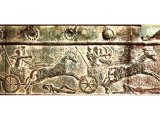 dominate their art and cultural production. In spite of this, the art of these millennia worth of culture created and exhibited an appreciation for beauty—lyric narratives like the epic of Gilgamesh, Mesopotamia’s visual and plastic arts, and poems like this possess their own artistic value. I suggest, I suppose, a connection between the primal behavior, the attitude toward the Gods, and fatalistic sadness in the attempt to create “order from the watery chaos”.
A quick note on Gilgamesh. I read this epic, with which I had an easy time at first, but upon has given me cause to reflect on it for a long time since finishing. Its story relates to the aforementioned scary themes of power and death. More profoundly, it has an underlying desperation and a weird, quiet search for answers. And in all of Mesopotamia’s narratives, the mythology and visually oriented works, one sees some fundamental questions with which we still grapple…What does it mean to be human? Self awareness defines itself relative to the world around the subject. The converse of that assertion, though, may resonate more with this period of cultural production—the nature of the world reveals and defines itself as a function of self awareness. Hence one explains the world with stories based on personal experience. This is why the literature and art of Mesopotamia profoundly illustrate the lived experience there. This query into human nature and the endeavor to explain or depict the world around us remains constant through to today as a part of a universal artistic commitment.
Coming up…a similar discussion of the tribe called the Hebrews or Israelites, and of the interpretations of the Old Testament. This topic ties closely into the discussion above, especially with regards to the overlaps in mythology and the appearance of Mesopotamian gods in the stories of a monotheistic culture. Then onto the Greeks and the real stuff of this project!








2 comments:
ok, reading.....
i actually was doing a bunch of other shit. it didnt take me THAT long to read it.
that's crucial, i'm so interested in that shit. i'm tryna go read all up on that.
Nietzsche's Will To Power?
sounds an awful lot like what we got today.
we aint come that far.
Post a Comment