
Part one of the Roman art story, and by extension of the society itself, seems to read psychologically raw--competition, alliances, and image. Art, as I suppose it always has, is a communicative form, but for the Romans it seems like its a medium reserved for a certain kind of message about the subject of the work or the guy who paid for it (usually the same thing). What I find particularly cool is all the figurative work of people in Roman art and their association with family pedigree, virtue and piety. I especially love the plethora of busts that abound of men and women, largely because I love seeing representations of the body used for reasons other than their function. The picture of the "togate male", dating from the late first century BCE, is one of my favorites...he's older, more contemplative, and carries on, both literally and figuratively, the tradition of his ancestral predecessors. His own seniority and experience are made obvious by his age and the piety he shows by bringing his ancestors into it, and by the simple fact that a sculpture was made of him. I can't wait to dig more into the concepts of virtue and piety in later posts.
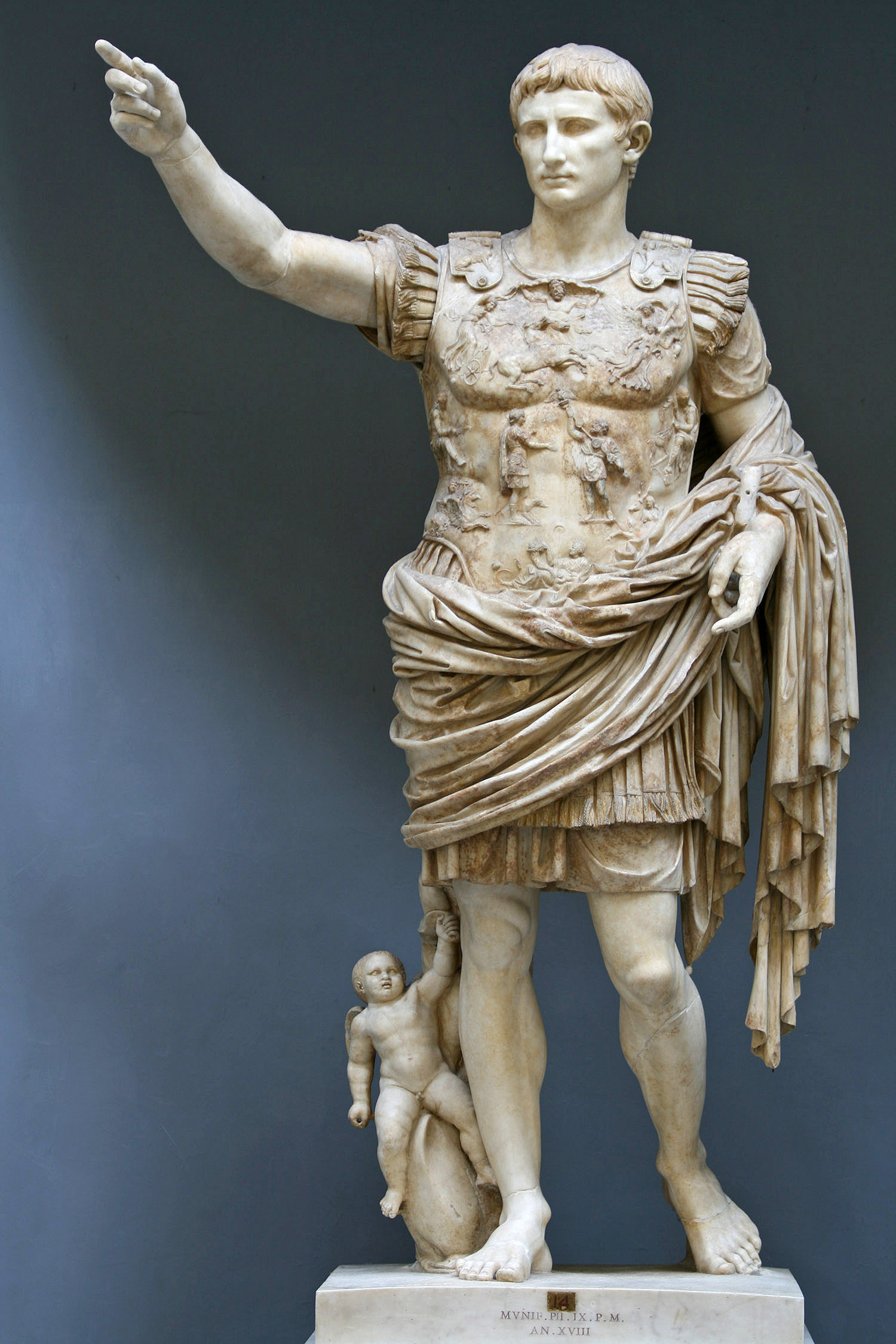
Note here also the talent of the sculptor to make this a stable sculpture...a pedestal to the man's right, and the toga reaching to the floor mask the wooden trusses likely found underneath the marble finish. Not to mention the details and the somewhat posed position of the man's posture. Compare to Augustus of Primaporta, who's in a modified contraposto, with the strut masked by the little baby Eros at his right leg (I will dig further into representations of Augustus in later posts. There's a lot to say on that).
The display of piety is certainly not limited to the ruling classes, either. See the relief sculpture here, in which to freed and married slaves show homage to their former master in the middle. Do they treat him as their adopted father, in the absence of real parents? Do they become part of his household, and show piety to the tradition therein?
Other bits and pieces from Rome's material culture tell a similar story. Bits and pieces indeed...observe the Ara Pacis Augustae, the Column of Trajan, the Arch of Titus...built to commemorate and glorify the achievements, even the fulfillment of a supernatural destiny, of the emperors of Rome, thus solidifying the form of government and placing the rulers at the levels of the gods. An old trick, to be sure, and a well used one since then. In addition, these monumental artifacts don't only tell a story about the society that produced them, they tell a story through the relief sculptures all over them. A narrative unfolds, telling the major events, the key players, and victories of huge battles in which the emperors emerge victorious and further glorify Rome.
The monumental architecture seems to be just as productive in terms of legitimating the ruling class, building "vulgar" theaters or coliseums to satisfy the masses, or erecting enormous temples to illustrate their commitment to the gods of their society (Roman religion, and Greek to a lesser extent, is something that I still don't feel like I have much of a handle on). Then again, as in the case of Pompey, the guy just really liked theater, and maybe he just wanted one. Or maybe those who financed the large temples to the Gods felt they actually owed something to a higher power, or wanted people to be more religious and contemplative. Certainly I can't speculate so one-sidedly as to everyone's intent. People just aren't that one-dimensional...are they? In all these cases, none the less, the innovative use of engineering technologies like arches and concrete made possible structures far greater in scale and stability than had been seen previously. I still find scale like that impressive.
This "glory of Rome" idea confounds me though. Is it like the commitment to the city-state and the polis, through participation and democratic process, in some parts of Greece? Or is it a patriotic ideal, sort of like how people (but certainly not me....er...) believe patriotism works now, getting people to fight and die for the expansion of the empire and the further buttressing of the ruling class that runs it (Republican Patriotism)? Now we're getting into some fantastically challenging concepts, like honor, piety, virtue, glory, etc.....
Perhaps the glory of Rome, though, is tied into my last point...I think the wealth of Greek statues and Greek copies says as much about Rome if totally original works had as well. Janson's calls it syncretism, a word I find perfectly fitting. This was a grand empire, in competition with no one. Following the age of intense competition throughout the Hellenistic era, when nothing seemed certain and no one's rule seemed safe, to have such a lasting society, in which no force could muster the strength to even make a sizable dent for centuries, must have been remarkable. Truly, only few had done so up to that time in the world's history, and even since. Like any empire, they seem to have had few things which were truly theirs, except for their own power and societal structure (enter piety, virtue, tradition...) The ruling classes had a near mania for antiquities from Greece and, to a lesser extent, Egypt, seems rather fitting as Rome took on the self-proclaimed role of torch bearer of civilization and human productivity. Funny, though, how civilization works, as Rome and its leaders likened themselves to other civilizations and leaders of the past, as if by further proof of their own important role in the grand design of things. See, the Pantheon.




1 comment:
Adam,
Nice to see the blog back up and running. I'm excited to see what is to come.
-Trip
Post a Comment