Exile from the mainstream, and the loneliness that seems to accompany it, is a transformative experience. The case of Ovid shows that it can lead to a new perspective on the sensed life (no rules, only false and possibly true). Ovid and his Metamorphoses are a case in point.
I've had cause to think extensively about Rome, and some larger sociological matters stemming from it. Social structures and institutions exist to sustain themselves. Augustus is not at fault for his actions as leader of Rome, at least not directly (although participation is complicity, and as such enables and propagates any system).
Ovid loved his life in Rome. He seems debauched to me. In a good way. He had affairs with married women, and wrote (e.g., Ars Amatoria) about successfully using lovers. Augustus, as part of the moral reforms, exiled Ovid to Tomis. Sort of silly when one considers that Horace fought in Brutus's army against Augustus and Mark Anthony, and his whole family had aligned against the Julio-Claudians. Maecenus took him on anyway, and he lived a very prosperous life, supported by what amounted to state-sponsored patronage. Was Ovid's behavior more dangerous in Augustus's view to the status quo that the emperor sought to create?
Ovid hated exile. He wrote Metamorphoses as a retelling of myths. I think Ovid thought about form and the body, stasis and change. He retold those myths that represented the miserable reality of flow and life. I wonder if he had read much of the pre-Socratic philosophers?
Human organizations resist this flow in favor of stability. To cease participating is to stop the transformation endemic to humanity. But liberation is lonely (and possibly an illusion). Ovid and I have decided not to get married. We don't have to. He visits me in my dreams, but doesn't speak. His presence alone is enough to make me realize which situations are actually exile, and which aren't. I haven't figured out yet what he means.
skip to main |
skip to sidebar

A Prelude, at least.


Contact
A.M. Hasler
Cambridge, Massachusetts
amhasler@gmail.com
The List
- Menander, Dyskolos.
- Callimachus, Hymns and Epigrams.
- The Battle of Issos. Museo Archeologico Nazionale, Naples (Mosaic copy of original painting).
- Tomb Paintings at Vergina, Macedonia.
- Apollo Belvedere. Musei Vaticani, Rome (Copy).
- Myron of Thebes, Drunken Old Woman. Glypothek, Munich (Copy).
- Aphrodite, Pan, and Eros. National Archaeological Museum, Athens.
- Pythokritos of Rhodes (?), Nike of Samothrace. Musee du Louvre, Paris.
- Dying Gallic Trumpeter. Museo Capitolino, Rome (Copy?).
- Portrait Head. National Archaeological Museum, Athens.
- Great Altar of Zeus at Pergamon. Staatliche Museen zu Berlin.
- City of Pergamon. Bergama, Turkey.
- Temple to Apollo at Didyma. Didim, Turkey.
- Reed Painter, White-ground lekythos. National Archaeological Museum, Athens.
- Niobid Painter, Red-figured Calyx krater. Musee du Louvre.
- Lysippos, Portrait of Alexander the Great ("The Azara Herm"). Musee du Louvre.
- Lysippos, Apoxyomenos. Musei Vaticani (Copy).
- Praxiteles, Hermes and Dionysos. Archaeological Museum, Olympia (Copy)
- Polykleitos, Doryphoros. Museo Archeologico Nazionale, Naples (Copy).
- Praxiteles, Aphrodite of Knidos. Musei Vaticani (Copy).
- Theater at Epidauros
- Vitruvius, On Architecture
- Ancient Greek Music and Dance
- Euclid, The Elements
- The Complete Works of Aristotle
- Plato, The Complete Dialogues
- Selected Texts of the Presocratic Philosophers
- Demosthenes, Third Philippic
- Gorgias, Encomium of Helen
- Isocrates, Panegyricus
- Xenophon, The Cyropaedia
- Thucydides, The History of the Peloponnesian War
- Herodotus, The Histories
- Hesiod, Theogony
- Aristophanes, Clouds/Birds/Frogs/Lysistrata
- Euripides. Bacchae
- Euripides. Hippolytus
- Sophocles. Ajax
- Sophocles. The Oedipus Cycle
- Aeschylus. The Orestia
- The Parthenon, and the buildings of the Acropolis. Athens
- Atlas Bringing Herakles the Apples of the Hesperides. Archaeological Museum, Olympia
- Battle of the Lapiths and Centaurs, Temple of Zeus, Olympia. Archaeological Museum, Olympia
- Riace Warrior A. Museo Archaeologico, Reggio Calabria, Italy
- Zeus or Poseidon. National Archaeological Museum, Athens
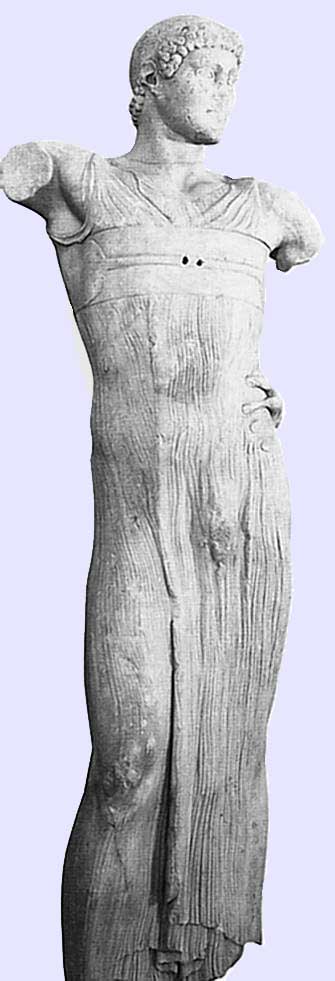
- Charioteer from Motya, Sicily. Museo Guiseppe Whitaker, Motya
- Kritios Boy. Akropolis Museum, Athens
- Eos and Memnon. Musee de Louvre, Paris
- Euthymides. Dancing Revelers. Museum Antiker Kleinkunst, Munich
- Exekias. Achilles and Ajax Playing Dice. Vatican Museums
- Dying Warriors, Temple of Aphaia. Staatliche Antikensammlungen und Glyptothek, Munich
- Battle of the Gods and Giants, from the north frieze of the Treasury of the Siphnians. Archaeological Museum, Delphi
- Central portion of the west pediment of the Temple of Artemis at Corfu. Archaeological Museum, Corfu
- Kore. Akropolis Museum, Athens
- Peplos Kore. Akropolis Museum, Athens
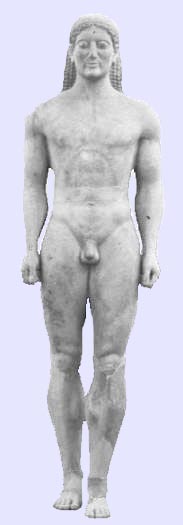
- Kroisos. National Museum, Athens
- Kouros. Metropolitan Museum of Modern Art
- Kore. Musee de Louvre, Paris.
- Temple of Hera II, Paestum
- Temple of Hera I, Paestum
- The Ajax Painter (An aryballos). Museum of Fine Arts, Boston.
- Man and Centaur. Metropolitan Museum of Art.
- Late geometric belly-handled amphora. Dipylon Master. National Archaeological Museum, Athens.
- Pindar, "Odes"
- Sappho, "Hymn to Aphrodite"
- Homer, The Odyssey
- Homer, The Iliad






Planning Booklist
- Joost-Gaugier, Measuring Heaven
- Warren, Presocratics
- Walker, Rhetoric and Poetics in Antiquity
- Snell, The Discovery of the Mind
- History of Political Philosophy, ed. Leo Strauss and Joseph Cropsey
- Bertrand Russell's History of Western Philosophy (New York: Simon & Schuster, 1974)
- The Teaching Company's Great Authors of the Western Literary Tradition
- Janson's History of Art
- Don't Know Much About the Bible
- Don't Know Much About Mythology
Tangents and My Favorite Blogs
Labels
- Aeschylus (1)
- Alexander (1)
- Ancient Italy (5)
- Ancient Literature (7)
- Antiquities trade (1)
- Appuleius (1)
- archaic (1)
- Archimedes (1)
- architecture (1)
- Aristophanes (1)
- Aristotle (3)
- Athens (2)
- Augustus (2)
- Bertrand Russell (6)
- Beth Harris (1)
- Bruno Snell (2)
- Callimachus (1)
- Cato (1)
- classical (4)
- Comedy (1)
- Constantine (1)
- Copernicus (1)
- Cosmology (1)
- Cradle of Civilization (1)
- Cultural Heritage (1)
- Cynics (3)
- Data (1)
- Demosthenes (1)
- Deuteronomy (1)
- Digital Learning (1)
- Dionysus (1)
- Dithyramb (1)
- early Christianity (3)
- Epicureans (2)
- epistemology (1)
- Etruscans (1)
- Euripedes (1)
- Fertile Crescent (2)
- Gilgamesh (1)
- Gnosticism (1)
- Gorgias (2)
- Great Library (1)
- Greece (9)
- Greek art (5)
- Greek Drama (1)
- Hebrews (1)
- Hellenistic Period (2)
- Heraclitus (2)
- Herodotus (3)
- Historical Jesus (3)
- History (5)
- Homer (3)
- housekeeping (1)
- Iliad (1)
- Introduction (6)
- Isocrates (5)
- Italic and Roman Art (4)
- Janson's (1)
- JEPD (1)
- Jews (2)
- Latin (2)
- Livy (1)
- logic (1)
- Lyric Poetry (2)
- mathematics (1)
- Mediterranean (3)
- Menander (2)
- Mesopotamia (1)
- Metamorphoses (2)
- Milliken report (1)
- Minoans (1)
- MLA (1)
- Mythology (4)
- National Gallery of Art (2)
- New Yorker (1)
- Nova (1)
- Odyssey (2)
- Old Testament (2)
- On Point (1)
- Oral Tradition (2)
- order/disorder (2)
- Ovid (1)
- parthenon (1)
- Petronius (1)
- Philosophy (2)
- Pindar (1)
- Plato (6)
- Plotinus (1)
- Poetics (3)
- Pompeii (2)
- Portable Antiquities Scheme (2)
- Presocratics (2)
- project page one (1)
- Pythagoras (3)
- Quantitative Modeling (2)
- republic (1)
- Rhetoric (6)
- Robert Strassler (1)
- Roman History (3)
- Roman literature (3)
- Roman Philosophy (2)
- Rome (9)
- Sappho (1)
- sculpture (2)
- smarthistory.org (1)
- Socrates (2)
- Sophocles (1)
- Stanly Fish (1)
- Steven Zucker (1)
- Stoics (3)
- Thucydides (1)
- Tragedy (1)
- Xenophon (1)
Blog Archive
Technorati
No comments:
Post a Comment